

30 Best Things to Do in the Black Hills, South Dakota
From the rugged and dramatic spires that make up the granite core of this stand-alone mountain range to windy scenic drives, historic mining towns, and stunning trails scattered throughout, the Black Hills of western South Dakota are truly a paradise for any type of traveler!
There are beautiful canyons, towering waterfalls, hidden swimming holes, and amazing places to eat, all scattered throughout this isolated mountain range that climbs to an elevation of 7,242 ft. (2,207 m), making the summit the highest peak in South Dakota!
That said, the Black Hills is a very big area, and I know firsthand how hard it can be to try and figure out what to prioritize over a short visit.
However, I have spent many weeks over numerous trips exploring the Black Hills, learning the best of everything there is to see and do, which is why I feel confident these recommendations are some of the best you will find among everything there is to consider!
What is the Best Time of Year to Visit the Black Hills?
I’ve been fortunate to experience the Black Hills multiple times during both the beautiful but popular summer season, as well as the cooler fall months, and my number one recommendation—by far—is to visit during the fall, which I believe for three main reasons.
The first is that fall in the Black Hills is a much cooler and more comfortable time of year to hike. I say this because the vast majority of trails in both the Badlands and Wind Cave have very limited shade, which can make hiking across the open prairie very hot—not to mention, the risk of afternoon thunderstorms is that much more increased in the summer.
However, visiting in the fall considerably mitigates all of these concerns, especially the risks associated with lightning, which cannot be overstated when hiking in the high peaks and across the open prairie.
The second—and perhaps more important—reason is that fall in the Black Hills is significantly less busy than the summer.
It’s no secret that the Black Hills is often treated as a drive-thru destination on a roadtrip further west, meaning visitors are lucky to dedicate more than a few days in western South Dakota as they drive across the state to get to the much more popular and iconic Grand Teton National Park and Yellowstone National Park in northwest Wyoming.
That said, summer is easily the most popular and beautiful time to visit the parks in Wyoming, and the traffic in the Black Hills is simply a byproduct of the popularity of the parks farther west.
Finally, and my favorite reason for saying this, fall in the Black Hills is stunning and largely uncrowded when it comes to enjoying fall colors—particularly the Aspens, as they change from green to yellow to gold!
To learn more about the fall colors in the Black Hills, don’t skip over my thoughts at the very end, where I talk in detail about the best time of year to visit for the colors, as well as some of the best places to see them across western South Dakota!
How to Plan a Roadtrip to Western South Dakota and Northwest Wyoming?
If you were to ask me, I would say that it’s certainly more than practical to see the best of the Black Hills, the Badlands, Wind Cave, Devils Tower, Grand Teton, and Yellowstone in one summer road trip—but it just takes time.
A one-week vacation is not the right way to try and visit the best of everything there is to see and do, but for a trip to all the places mentioned above, I recommend traveling for closer to a month.
Now, I definitely hear the way that comes across, as most people can’t take that much time off work, which is why I would honestly recommend two trips over one.
Western South Dakota and Devils Tower can easily be their own trip, considering all there is to see and do, but as for the parks in northwest Wyoming, including the Beartooth and Wind River Mountain Ranges, this is a place that you don’t want to rush.
The Yellowstone–Teton area is, without a doubt, one of the best and most beautiful places to visit in the entire country—and the world—which is why I strongly recommend against trying to cram in all there is to see in South Dakota and Wyoming into one trip.
This is certainly just one person’s opinion, but if you were to dedicate less time on one trip to South Dakota and more time to northwest Wyoming on a different trip, it may not be impractical to fit in Glacier National Park for a trip closer to, or longer than, two weeks.
Hiking Checklist - South Dakota
According to the South Dakota Game, Fish and Parks (GFP) and the U.S. Forest Service, there are Black Bears in South Dakota, but encounters are considerably rare.
That said, here is a complete list of must-have things that you will want for any hike in South Dakota.
30 Best Things to Do in the Black Hills
The following list is written in no particular order of best or worst.
Rather, it’s written by location, keeping nearby destinations next to one another, in order to help plan what is realistic to fit into your day as you drive through the Black Hills.
On a different note, you can save time when you arrive by purchasing your National Park pass, along with your other outdoor gear, at REI before traveling to the park!
1. Wind Cave National Park
Located on the southern end of the Black Hills, Wind Cave National Park is truly two different worlds apart, considering both across the wildlife and trails that span the open prairie and the tours inside Wind Cave itself!
That said, I have spent quite a bit of time in Wind Cave National Park, enjoying both the guided tours in Wind Cave, as well as exploring all the different day hikes across the park.
This is why, I highly recommend reading my separate post to learn all about the best guided tours, how to time them, how to get reservations, and what trails to prioritize, given that there are so many to consider on all sides of Wind Cave National Park!
Read My Separate Post: Wind Cave National Park
2. Mount Rushmore National Memorial
Distance: 0.6 miles / 1.0 km
Mount Rushmore National Memorial is an iconic, must-see national landmark that I personally think is best enjoyed by hiking the short 0.6-mile (1.0 km) Presidential Loop, as the trail allows visitors the opportunity to learn about each of the four presidents featured and how the monument was carved when it passes the Sculptor’s Studio on the return side of the loop.
Before visiting, know that most federal recreation passes do not cover the parking fee at Mt. Rushmore, with some limited exceptions, including active U.S. military personnel with a valid ID.
Read My Separate Post: Presidential Trail
3. Drive the Peter Norbeck Scenic Byway
The Peter Norbeck Scenic Byway, also called Iron Mountain Road, is a stunningly beautiful drive that is often less talked about compared to the iconic Needles Highway in Custer State Park!
That said, the 16.5-mile (26.6 km) drive connects Keystone on the northern end with Highway 36, just a few miles west of Hermosa.
Before making the drive, know that Iron Mountain Road has height and width requirements for vehicles, as the winding scenic drive passes through three mountain tunnels, with the smallest being the Scovel Johnson Tunnel at 10 ft. 9 in. (~3.3 m) wide by 11 ft. (~3.4 m) high.
All that aside, the Peter Norbeck Scenic Byway is not only a great time for a number of beautiful viewpoints looking across the Black Hills, but for unique views of Mount Rushmore that can’t be seen from anywhere else, including the National Memorial itself.
Google Maps Directions: Peter Norbeck Scenic Byway (Norbeck Overlook)
4. Crazy Horse Memorial
The Crazy Horse Memorial is an iconic granite sculpture in the Black Hills, just to the north of Custer, dedicated to honoring the Lakota leader Crazy Horse and the culture of numerous Native American tribes.
Unlike most other destinations in the Black Hills, Crazy Horse is privately owned, operated, and funded, which is why the memorial is still under construction today.
If you’re visiting for the first time, know that visiting Crazy Horse is much more about the education center than the mountain, as the viewing platform is quite far away from the actual sculpture. The reason this photo looks so close is because it was shot on a telephoto lens, but in reality, photos don’t usually turn out this well without some kind of long lens.
On a different note, there is one hidden secret about Crazy Horse that occurs just twice a year, which is when the mountain is opened to the public to hike!
If you happen to be visiting the Black Hills on one of these days, be sure not to miss this event, as so few visitors actually get to see Crazy Horse up close, as you do on the hike up the mountain.
Google Maps Directions: Crazy Horse Memorial
5. Sage Creek Grille (Custer)
Sage Creek Grille is one of the nicer places to dine in for dinner in Custer, just to the north of Wind Cave National Park, but I largely write this recommendation because Sage Creek Grille is a great place to try a Bison steak!
That said, Bison steaks are a must-try if you’ve never had one before, but they are a lot leaner than any other cut of steak you’re likely used to.
This is why it’s important to try a Bison steak from a place that will know how to cook it to order, with my personal recommendation leaning toward the rarer side, because it’s a tougher meat than beef.
Either way, there’s a lot more to the menu at the Sage Creek Grille that’s sure to help anyone in your group find something they’ll love!
Yelp: Sage Creek Grille
6. Wildlife Loop Road
Wildlife Loop Road is an 18.1-mile (29.1 km) scenic drive in Custer State Park that connects Highway 16A on the northern end to Highway 87 on the southern, the same main road that leads into Wind Cave National Park.
Regardless of the entrance you chose to begin, Wildlife Loop Road is really all about getting on the road, moving at your own pace, and simply looking for whatever you can find, including Bison, Elk, Pronghorn, Prairie Dogs, and, in the rare off chance, a Black Bear!
Google Maps Directions: Wildlife Loop Road
7. Little Devils Tower Trail
Distance: 2.8 miles / 4.5 km
Suggesting just Custer State Park and leaving it at that would be a bit of a lazy recommendation, which is why I wanted to dive deeper and highlight all the best things to do on this list, as Custer is truly one of the best and most beautiful places to visit in the Black Hills of western South Dakota!
That said, the Little Devils Tower Trail is my number one recommendation in Custer State Park because it’s such a fun, easy, and beautiful day hike, but most importantly, it’s the best sunset hike across the Black Hills!
Before visiting, I highly recommend reading my separate post, as there are a few short scrambling sections leading to the summit that some hikers may have difficulty navigating.
Read My Separate Post: Little Devils Tower Trail
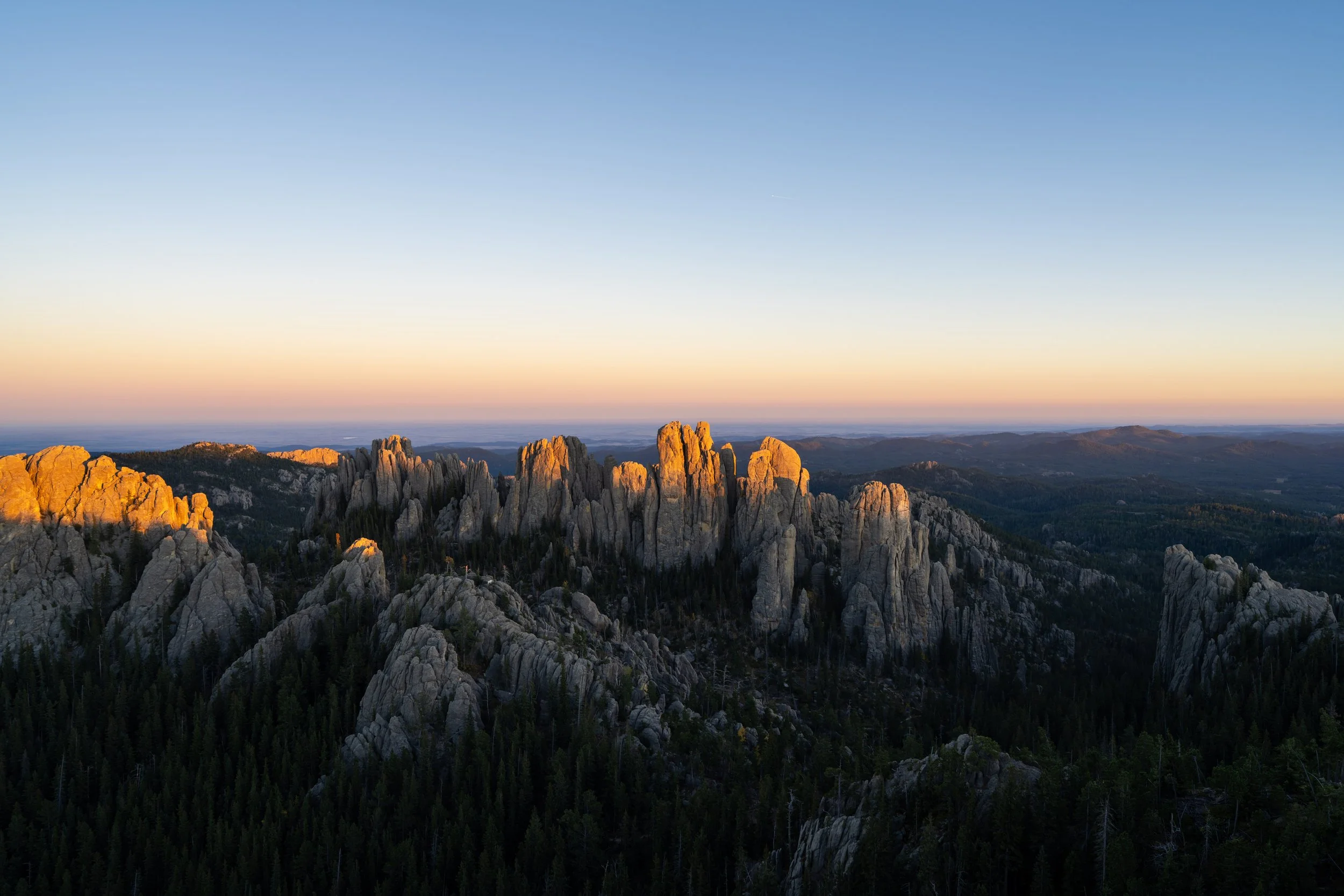
My Print - Little Devils Tower Trail (Sunset)
8. Drive the Needles Highway
The Needles Highway in Custer State Park is a narrow, windy, scenic byway through one of the most fun and beautiful stretches of road in the Black Hills, passing iconic spots along the way such as Sylvan Lake, the Needles Eye Tunnel, the Cathedral Spires Trail, the Little Devils Tower Trail, and a number of other unnamed scenic viewpoints!
That said, if you plan to hike some of the best trails in Custer State Park, you’ll inevitably drive the best and most beautiful parts to get to the different trailheads off the highway, making the drive one of the best places to spend a full day!
Similar to Iron Mountain Road, the Needles Highway also has a height and width requirement for vehicles, as the winding scenic drive passes through the one-lane Needles Eye Tunnel, which measures 8 ft. (2.4 m) wide by 9 ft. 9 in. (~3 m) high.
Google Maps Directions: Needles Highway (Needles Eye Tunnel)
9. Cathedral Spires Trail
Distance: 1.8 miles / 2.9 km
The Cathedral Spires Trail is a fairly easy, beautiful day hike in Custer State Park, and because of this, it’s also one of the most popular trails off the Needles Highway!
Before setting off, there are a few things to know regarding the very limited parking situation, as well as the best times of day to hike the trail.
This is why I recommend reading all the details in my separate post, as the best photos are often taken when you’d least likely want to visit, based on where the sun rises and sets, as well as visitor traffic.
Read My Separate Post: Cathedral Spires Trail
10. Black Elk Peak Trail (Highest Peak in SD)
Distance: 6.8 miles / 10.9 km
Elevation Gain: 1,050 ft. / 320 m
The Black Elk Peak Trail via Custer State Park is a stunning day hike through some of the most beautiful granite formations the Black Hills has to offer, ultimately ending at the Harney Peak Lookout—the highest peak in South Dakota!
That said, hiking up Black Elk Peak is not a difficult adventure by any means, as the trail to the summit is very gradual for what climbing to the highest peak in the state truly could be.
To add to this, the Black Elk Peak Trail via Sylvan Lake in Custer State Park is one of the best places to enjoy the fall colors in the Black Hills, as beautiful golden Aspens follow the trail all the way to the summit, making the hike that much more spectacular if you catch it at the right time of year!
Read My Separate Post: Black Elk Peak Trail
11. Sunday Gulch Trail
Distance: 4.1 miles / 6.6 km
Elevation Change: 550 ft. / 168 m
The Sunday Gulch Trail is arguably the most unique day hike in Custer State Park, as the trail descends a series of railings and staircases through a winding, narrow, beautiful gulch on the west side of Sylvan Lake!
After navigating these fun sections through Sunday Gulch, the trail then loops back around to the other side of the Sylvan Lake Shore Trail, making the adventure feel like two hikes in one!
Before visiting, I recommend reading my separate article, as there is a beautiful, narrow slot canyon on the return side of the loop that can be easy to miss if you take one of a few wrong turns when the trail nears Sylvan Lake.
Read My Separate Post: Sunday Gulch Trail
12. Jewel Cave National Monument
Distance (Roof): 0.4 miles / 0.6 km
Distance (Canyons): 3.6 miles / 5.8 km
Jewel Cave National Monument is a small National Monument by land area, but, like Wind Cave National Park, hosts an expansive underground network of caves that is far from being mapped in its entirety!
That said, I personally think Jewel Cave is absolutely worth the visit, but don’t think it’s worth more than spending a few hours.
By this, I mean that booking either the Scenic Tour or the Discovery Tour are easily the two most popular options, but apart from the guided tours offered through the National Park Service, I recommend planning to spend more time elsewhere—especially when it comes to hiking.
I don’t write this to suggest that the two day hikes in Jewel Cave National Monument are bad by any means, but I simply mean that if time is a factor on your trip, I recommend planning to hike in Wind Cave National Park or the Black Hills over the trails in Jewel Cave.
However, if you have more time to spare, either before or after a scheduled cave tour, I recommend checking out the Roof Trail for the shortest and easiest option, or the Canyons Trail, which encompasses much of the Roof Trail.
Read My Separate Posts: Roof Trail / Canyons Trail
13. Custer Peak Trail
Distance (RT via NF Boundary): 4.6 miles / 7.4 km
Distance (RT via Middle TH): 2.4 miles / 3.9 km
Distance (RT via Upper TH): 0.5 miles / 0.8 km
Custer Peak is an isolated, stand-alone summit in the northern Black Hills, where visitors can hike their way up to a historic fire lookout with panoramic views across the greater area!
There are three different distances listed above because, depending on the type of vehicle you’re driving, you may be able to get much farther than the lowest trailhead, located 2.3 miles (3.7 km) from the summit.
This is why my separate post linked below begins from the lowest trailhead at the National Forest boundary, which helps to show all aspects of the dirt road leading up to the summit, including the difficult sections where a high-clearance, 4x4 vehicle is necessary.
Read My Separate Post: Custer Peak Trail
14. Deadwood, South Dakota
Deadwood, South Dakota is a historic mining town tucked into the northern Black Hills, famous for its Wild West roots and larger-than-life characters, like the legendary Wild Bill and Calamity Jane.
Founded during the 1870s gold rush, Deadwood quickly became known for lawlessness and fortune seekers, which has been preserved in its architecture and stories, making it a fun place to experience some of America’s historic frontier past.
Today, Deadwood is best known for its historic Old West charm, a number of saloons, and, of course, gambling! Yes, Deadwood is the only place in South Dakota where gambling off reservations is allowed by state law.
All this to say, Deadwood may not be the most kid-friendly town in the Black Hills, but it’s certainly worth stopping through, even if only to walk around for an hour before driving elsewhere.
Google Maps Directions: Deadwood, South Dakota
15. Drive the Spearfish Canyon Scenic Byway
The Spearfish Canyon Scenic Byway is an 18.5-mile (29.8 km) scenic drive between Spearfish, off I-90 on the northern end, and the Cheyenne Crossing at the southern.
The drive is renowned by both locals and visitors alike for a number of very short but beautiful day hikes, as well as some of the best fall colors the Black Hills has to offer! I recommend following the Spearfish Canyon Color Report for the most up-to-date local color conditions if this is something you’re interested in planning.
However, there is truly a benefit to driving Spearfish Canyon throughout the year, as swimming in Spearfish Creek and the Devil’s Bathtub is best enjoyed during the warmer summer months.
If you’re not into hiking, the relatively short 13.2-mile (21.2 km) out-and-back drive between Spearfish and Savoy is worth the trip alone, as Spearfish Falls can be enjoyed with very little effort—not to mention the Latchstring Restaurant is a great place to stop and grab a meal.
Google Maps Directions: Spearfish Canyon Scenic Byway
16. Spearfish Falls Trail
Distance: 0.8 miles / 1.3 km
There are a number of waterfalls off the Spearfish Canyon Scenic Byway, but none are as beautiful or iconic as Spearfish Falls near the Savoy Junction!
That said, Spearfish Falls is easily the most popular destination in Spearfish Canyon, and I would say that if you don’t have a lot of time to spend, the relatively short drive from Spearfish off I-90 to the Savoy junction is worth prioritizing, considering how quickly the drive through the canyon goes truly moves!
Read My Separate Post: Spearfish Falls Trail
17. Devil’s Bathtub Trail
Distance (Roundtrip): 1.6 miles / 2.6 km
The Devil’s Bathtub is the best hidden swimming hole in Spearfish Canyon!
This is why I like to say that, even though Spearfish Canyon is through and through a fall destination, it’s certainly worth visiting throughout the mid-summer months, as hiking on one or a few of the beautiful trails within the canyon, followed by a swim in the Devil’s Bathtub, is a great way to finish off a hot summer day!
Read My Separate Post: Devil’s Bathtub Trail
18. Eleventh Hour Gulch Trail
Distance: 0.3 miles / 0.5 km
Eleventh Hour Gulch is arguably the best hidden gem in not only Spearfish Canyon, but across the Black Hills!
Now, that certainly is a bold statement, but this seemingly unimpressive gulch off the highway really is a fun little trail to scramble up a number of big boulders and ladders, ultimately ending at a beautiful view above the Spearfish Canyon Scenic Byway!
Read My Separate Post: Eleventh Hour Gulch Trail
19. Community Caves Trail
Distance: 0.6 miles / 1.0 km
The Community Caves Trail is a lot like the Eleventh Hour Gulch Trail mentioned above, in that it is not a managed or maintained trail.
That said, this roadside hidden gem is a short but steep hike up to an alcove of small caves off the highway, where visitors can enjoy beautiful views of the canyon, take unique photos framed by the different caves, and spot birds nesting in the hidden burrows scattered across the walls and ceilings of the caves!
Read My Separate Post: Community Caves Trail
20. REDwater Kitchen (Spearfish)
I’ve speak highly about every restaurant on this list because I have truly spent so much time exploring western South Dakota, which has allowed me to try the good, the bad, and everything in between. I mean it when I say there are a few places I wouldn’t even consider putting on this list.
However, the recommendations on this list truly deserve to be here!
I write all this because when I write about the REDwater Kitchen specifically, I want to stress that I mean it when I say: I had the best pasta I’ve ever eaten at the REDwater Kitchen in Spearfish!
There’s only one other time on this huge blog that I’ve given such a glowing recommendation, which is when I ate the best steak of my life in Tusayan, Arizona, just outside of the South Rim of the Grand Canyon.
All of this to say, I highly recommend trying the Rabbit-Rattlesnake Sausage Pasta, which may sound weird, but wow, it was incredible!
Yelp: REDwater Kitchen
21. The Original Spearfish Breakfast House
The Original Spearfish Breakfast House, just off I-90, is the best local breakfast spot outside the Spearfish Canyon Scenic Byway!
Personally, I recommend stopping in to eat before setting off on the beautiful, windy drive, as Spearfish Canyon really can be a full day of adventures if you plan to pack in a number of the trails I’ve highlighted in the post, including other popular adventures in the canyon, like the 76 Trail and the Roughlock Falls Trail.
22. Badlands National Park
Badlands National Park is certainly the odd one out when talking about the Black Hills in western South Dakota, but I definitely couldn’t write this list without including one of the most beautiful destinations in the state!
That said, I’ve written an entirely separate post about Badlands National Park, where I not only highlight the best things to do—including the best trails and beautiful overlooks—but also hidden secrets, such as where the best places are to explore off-trail, given the park’s open-hiking policy.
For this reason, I highly recommend reading my separate post in detail—especially if you’re trying to prioritize your time and stick to the best overlooks and the best times of day to be at each overlook!
Read My Separate Post: Badlands National Park
23. Wall Drug Store
I mean, did you even visit the Badlands if you didn’t sit on the giant Jackelope at Wall Drug..?
Jokes aside, Wall Drug is an iconic staple in the Badlands, as it has served as a roadside stop for travelers since they first opened their doors in 1931!
Needless to say, Wall Drug has grown over the years since its humble beginnings and lure of free ice water, where travelers today can stop in to shop, eat, and of course—sit on the giant Jackelope!
All this to say, there really is too much to try and fit into a couple sentences when it comes to visiting Wall Drug, as they have everything from different shops and ice cream to a U.S. post office, an art gallery, and so much more! However, among all there is to do at Wall Drug, don’t leave without trying a slice of their famous pie!
Google Maps Directions: Wall Drug Store
24. Salty Steer (Wall)
There are a number of steakhouses in Wall, outside of Badlands National Park, but my go-to place for dinner is the Salty Steer, as everything—from their burgers and steaks to their pasta and local beer—is incredible!
Yelp: Salty Steer
25. Stratobowl Rim Trail
Distance (RT to Stratosphere Bowl Overlook): 1.7 miles / 2.7 km
Distance (RT to Spring Creek Canyon Overlook): 2.2 miles / 3.5 km
The Stratobowl Rim Trail is a very easy, kid-friendly day hike just outside of Rapid City, where hikers wind their way through the Ponderosa Pines to a beautiful overlook of a natural amphitheater known as the Stratosphere Bowl, or Stratobowl for short.
Historically, the Stratobowl is known as the "Birthplace of the Space Age" because it served as the launch site for record-breaking high-altitude balloon flights that began in the 1930s.
Much more can be learned about these missions and their significance on the memorials at the end of the trail, but if you are looking for a quick, easy, and convenient day hike near Rapid City, I highly recommend checking out the Stratobowl Rim Trail!
Read My Separate Post: Stratobowl Rim Trail
26. Beau’s Diner (Rapid City)
Beau’s Diner in Rapid City is the best hometown breakfast diner in western South Dakota!
Think big portions, veterans telling war stories, coffee that keeps on coming, and reasonable prices at this local hidden gem!
Yelp: Beau’s Diner
27. Graffiti Alley (Art Alley)
In the heart of downtown Rapid City is a little-known side street behind some of the best restaurants in town, known locally as Graffiti Alley, or Art Alley.
This is one of those things that I wouldn’t necessarily say is worth driving out of the way for if you aren’t in the area, but since it’s located just around the corner from some of the best coffee shops and restaurants downtown, like Tally’s Silver Spoon, I recommend walking over if you’re already in the area!
Google Maps Directions: Graffiti Alley (Art Alley)
28. Ma Cualli (Rapid City)
Ma Cualli is a local Mexican restaurant in Rapid City that I would argue is one of the best local restaurants to eat at when you’re in the area!
I say this because it’s one of those places where everything on the menu looks and smells amazing, making it hard to pick just one entrée!
Yelp: Ma Cualli
29. Buzzards Roost Trail
Distance (Full Loop): 2.9 miles / 4.7 km
The Buzzards Roost Trail is a little-known hidden gem just outside of Rapid City that makes for a quick and easy adventure when you’re looking to hike something beautiful, uncrowded, but not too difficult!
On top of this, the Buzzards Roost Trail is the best sunset hike near Rapid City, though my number-one recommendation across the Black Hills still goes to the Little Devils Tower Trail in Custer State Park!
Read My Separate Post: Buzzards Roost Trail
30. Devils Tower National Monument
Devils Tower National Monument is the most out of the way, in terms of everything in the Black Hills, but between Yellowstone and Grand Teton National Park in northwest Wyoming, Devils Tower is easily the best and most popular place to stop and visit!
Among everything there is to see and do at Devils Tower, the Tower Trail is easily the most popular adventure, but if you have more time to spend, I’ve hiked all the best day hikes within the National Monument, which you can read more about in each of my separate posts linked below!
Read My Separate Posts: Tower Trail / Joyner Ridge Trail / Red Beds Trail
Additionally, I’ve included these tours because the Black Hills truly is a very big area, with so much to try and see!
This is why, if you’d feel more comfortable seeing and learning about the Black Hills from a local guide, some of the tours out of Rapid City may be the right option for you, which can either be booked as a group or private experience.
5 Best Things to Do Near the Black Hills
Western South Dakota is often the starting point, in terms of destinations, on a much longer road trip west, which is why I wanted to highlight a few of the best things to do beyond Devils Tower in eastern Wyoming.
1. Yellowstone National Park
In this part of the country, Badlands National Park, Wind Cave National Park, and the Black Hills are most often combined with a roadtrip across Wyoming to visit both Yellowstone National Park and Grand Teton National Park. The drive from Rapid City to the East Entrance near Sylvan Pass, west of Cody, WY, is roughly 7 hours, which really isn’t all that bad considering most people make the long drive across Wyoming starting from Devils Tower, not Rapid City.
That said, Yellowstone National Park is a very big National Park that can feel overwhelming when visiting for the first time.
I say this because there truly is so much to see and do beyond the most iconic stops, like Old Faithful. This is why, I highly recommend reading my separate article linked below, as I have been fortunate to visit many times over many years, which is why I’m confident my local insights—including places to see wildlife, trails, food, camping, and so much more—are truly the best recommendations you will find!
Read My Separate Post: Yellowstone National Park
2. Grand Teton National Park
One certainly can’t talk about Yellowstone National Park without highlighting Grand Teton National Park just a few miles to the south, as the two really go hand in hand, just like the Badlands and Wind Cave!
As for Grand Teton, the National Park and Jackson, Wyoming, are often more enjoyed by the more adventurous types of visitors, as the rugged Teton Range truly is a playground—from the easiest of trails, like the Jenny Lake Loop Trail, to popular off-trail adventures, like the hike up to Delta Lake.
In either case, I have also visited Grand Teton National Park many times over many years, as I have Yellowstone, which is why I highly recommend checking out my separate post for the best insider secrets and information before visiting!
Read My Separate Post: Grand Teton National Park
3. Sacred Rim Trail
Distance: 3.7 miles / 6.0 km
When driving from western South Dakota to visit northwest Wyoming, the vast majority of visitors skip Pinedale and the Wind River Range, just an hour-and-25-minute drive south of Jackson.
However, I hope the photo below speaks for itself, as the Sacred Rim Trail is arguably the best day hike across the entire Wind River Range!
That said, the Sacred Rim Trail is not a managed or maintained by the National Forest Service, similar to the Delta Lake Trail in Grand Teton National Park.
This is why I recommend reading my separate post to learn more about hiking to this hidden viewpoint—and don’t forget to bring a bug net before visiting! I can almost guarantee you will want one at any time during the warmer summer months!
Read My Separate Post: Sacred Rim Trail
4. Beartooth Highway
Soaring to an elevation of 10,947 ft. (3,337 m) at Beartooth Pass, the Beartooth Highway is easily one the best and most beautiful scenic drives on the planet, especially if you have the opportunity to hike around the pass at golden hour!
That said, the Beartooth Highway is rarely a convenient drive, whether coming to or from Yellowstone, but I can confidently say that it’s absolutely worth the detour, regardless of the time it adds to your drive!
Google Maps Directions: Beartooth Highway
5. The Beaten Path Trail
Distance: 26.0 miles / 41.8 km
The greater Yellowstone–Teton area is a renowned destination for backcountry hikers, but no adventure may be as beautiful or as pristine as The Beaten Path in the Beartooth Mountain Range north of Yellowstone!
Personally, I have only hiked about the first 8.0 miles (12.9 km) of The Beaten Path to Rainbow Lake before had to unfortunately turn around without completing the full trail.
This is why the article linked below is far from complete, but I have every intention of hiking the full trail and updating this article later in 2026!
Regardless, it only took a few miles of hiking for the Beartooth Mountains to instantly become my favorite mountain range across the Mountain West, which is why The Beaten Path is my number-one recommendation if you’re looking for a beautiful backpacking trip in the area!
Read My Separate Post: The Beaten Path Trail

My Print - Rainbow Lake
5 Things to Know Before Visiting the Black Hills
1. For the most part, driving through the Black Hills moves fairly quickly.
Across the Mountain West, windy canyon drives are typically very long and slow-going, but in the Black Hills, almost all of the major highways move very quickly!
There are obviously exceptions to this sentiment, which include the Needles Highway and the Peter Norbeck Scenic Byway, but these are two examples that you’re not driving to make good time anyway.
This is why, if you’re looking for somewhere to stay, Rapid City really can be a good option, considering how many major highways branch out from town and into the hills, while being conveniently located to I-90 to get to Spearfish, Devils Tower, and Badlands National Park!
2. Hiking is very exposed in both Wind Cave and Badlands National Park.
The Ponderosa Pines that give the Black Hills their iconic name are great for providing shade when hiking across the high country, but the same cannot be said about the wide-open prairie that extends across much of the Badlands and Wind Cave National Park.
By this, I mean that both parks are essentially one big exposed landscape, which is why the vast majority of the hikes in each park have little-to-no shade.
This is also why I mentioned in the beginning that fall is one of the best seasons to visit, as hiking during the hottest summer months can not only be exhausting but dangerous.
Aside from the heat, summer afternoon thunderstorms are a serious risk across the Black Hills and the Mountain West in general, which is why it’s imperative to know the forecast before setting off on any adventure.
However, I can speak from experience that even the best planning still warrants knowing what to do in the worst-case scenario with lightning overhead, which is why I highly recommend learning how to react if you’re caught in a thunderstorm and find yourself as the tallest object around.
National Park Service: Lightning Safety Tips
3. The Black Hills is an uncrowded, hidden gem for enjoying fall colors!
Compared to countless other popular destinations for fall colors across the U.S., including Acadia National Park and countless mountain towns in Colorado and other states, the Black Hills is one of the best hidden gems when it comes to amazing colors and few, if any, other people!
Some of the highlights include Spearfish Canyon, the Black Elk Peak Trail, and the Little Devils Tower Trail, to name a few—not to mention that hiking is that much more comfortable in the National Parks this time of year!
Before planning a trip, know that general the best time to visit is the last week of September and the first week of October, with a few days on either side of October 1st being the best.
That said, this really is just an average, and to know for sure, there are at least two sources I recommend checking.
The first is the national fall foliage map linked below, but there is also a more up-to-date color report specifically for Spearfish Canyon that is the best and most accurate source.
This is why, if you already have a trip planned to western South Dakota around this time of year, I recommend checking the Spearfish Canyon Report daily, with the intention of making it a last-second day trip, so that you don’t miss the best of the colors!
Explore Fall: Fall Foliage Map
Visit Spearfish: Spearfish Canyon Color Report
4. Spend more than one day in each of the National Parks.
I think it’s unfortunate, but the average visit to both Wind Cave and Badlands National Park is just one day, and frankly, that’s not enough time!
Now, I personally favor longer stays over shorter ones, but I do not believe one day is enough time to get the best of both parks.
Instead, I recommend at least two full days in each park—if not three—which allows for a much more comfortable and relaxed visit, especially considering how rushed and exhausting it can be to drive and stop over and over at each overlook in Badlands National Park.
However, with at least two days, you can allow yourself more time to stretch your legs on each of the park’s best trails, such as the Rankin Ridge Trail in Wind Cave National Park, as well as strategically plan different viewpoints for different times of the day in the Badlands, as opposed to cramming them all in at once.
5. Rapid City is a fairly practical place to stay when visiting the Black Hills.
In many areas across the Mountain West, such as Yosemite, Crater Lake, Lassen Volcanic, and countless more, the biggest nearby city—or any town, for that matter—is often a long, remote drive to get to and from.
However, Rapid City is very centrally and conveniently located to all the best things to do in and around the Black Hills, making a drive in any direction fairly easy—especially considering how convenient I-90 is to a number of the major highways that cut through the Black Hills.