

35 Best Things to Do in Yellowstone National Park
From one-of-a-kind volcanic geysers and thermal features to the towering peaks of the Absaroka-Beartooth Mountains, Yellowstone National Park is a world-renowned destination that has been welcoming visitors for more than 150 years to experience the raw beauty of a truly vast and untamed wilderness, filled with wildlife that is often regarded as the best in the Lower 48 states!
It is for all these reasons that Yellowstone can feel like an overwhelming National Park—most notably because of its size—making it challenging to truly feel like you’ve experienced the best of all there is to see and do. This is why I never recommend visiting Yellowstone National Park for anything less than four days, and this same sentiment goes for Grand Teton National Park, just to the south.
I say this because there are simply too many things to see and too much driving between all of the best locations within Yellowstone to try to make it a quick trip, which is why I recommend staying in more than one location in and around the park. This could be Gardiner and West Yellowstone—both located just over the border in Montana—Cody, WY, on the east side of the park, or any of the beautiful lodging options within Yellowstone mentioned below. That said, the town of Jackson, WY, near the Tetons to the south, is just too far to make it a practical place to stay when visiting Yellowstone.
All this to say, I’ve been visiting Yellowstone National Park since I was a little kid, and since then, Yellowstone has become a bit of a pastime over countless repeat visits, which is how this list got to the size it is today!
This is why I believe my long-running list of things to do is truly some the best things to do across Yellowstone National Park—especially my experience climbing the Crow’s Nest atop the Old Faithful Inn!

My Print - Lion Geyser
What is the Best Time of Year to Visit Yellowstone National Park?
The major roads that make up the figure eight in Yellowstone National Park typically open to passenger vehicles by Memorial Day weekend each year, with some seasonal variability.
However, the roads simply being snow-free is not indicative that Yellowstone is open in all capacities, as the park sits at an average elevation of around 8,000 ft. (2,438 m).
This means that the winter snowpack typically sticks around and covers many of the park’s trails through most of June, clearing almost entirely by mid-July. That said, I have seen it snowing midday in early August, though that was quite the rare anomaly.
With all that in mind, the best time to visit Yellowstone National Park is mid-July through the peak fall colors around the last week of September and into the first week of October.
By planning a mid-summer trip, all the best trails should be snow-free, fishing will have opened up entirely, and the best of Yellowstone can truly be enjoyed as it was meant to be!
Hiking Checklist - Yellowstone-Tetons
Obviously, for camping, you will need general backpacking gear. For this reason, I wrote a separate post about what backpacking gear is worth the money, from my experience, and what the best alternatives are to save you money.
Read My Separate Post: Best Ultralight Backpacking Gear
In addition, here is a complete list of must-have things that you will want for any hike in the Yellowstone-Teton area.
35 Best Things to Do in Yellowstone National Park
The following list is written in no particular order of best or worst. Rather, I’ve listed things together in terms of proximity, meaning what’s close one another when driving through the park.
On a different note, you can save time when you arrive by purchasing your National Park pass, along with your other outdoor gear, at REI before traveling to the park!
1. Old Faithful Geyser
Old Faithful to the American West is as iconic as apple pie on the Fourth of July!
My humor aside, Old Faithful is a loaded topic when talking about Yellowstone National Park because, beyond the geyser itself, there are countless different things to do, all centered around this one spot in the Upper Geyser Basin.
This is why my best advice for visiting Old Faithful is to arrive with the intention of staying a while. That could mean arriving first thing in the morning and hiking around all day, planning one or a few nights in the lodging around Old Faithful, or, at the very least, catching the eruption followed by exploring all the different historic buildings that surround the geyser.
Either way, Old Faithful is so much more than simply catching the eruption, but so if you do plan to stay a while, don’t miss grabbing a cold beer at the Old Faithful Inn and watching the eruption at sunset. I’ll talk more about this little secret below!
Google Maps Directions: Old Faithful
2. Crow’s Nest (Old Faithful Inn)
The Crow’s Nest is a little-known hidden gem atop the historic Old Faithful Inn, where visitors who plan ahead—or get lucky—can climb to one of the most beautiful viewpoints within and on top of the early-1900s-era inn above Old Faithful and the Upper Geyser Basin!
That said, the Crow’s Nest is easily the most exclusive tour in Yellowstone National Park, and there is a lot to know if you want to be one of the lucky few who get the opportunity to see this hidden side of Yellowstone.
This is why I highly recommend reading all the details in my separate post, because from experience I can honestly say that visiting the Crow’s Nest is one of the best things I’ve ever done in Yellowstone, as reaching the top had been a childhood dream of mine until I was finally able to turn that dream into a reality!
Read My Separate Post: Crow’s Nest in the Old Faithful Inn
3. Old Faithful Inn
Aside from the Crow’s Nest, the Old Faithful Inn deserves a visit at the very least!
I say this because it’s hard not to romanticize the historic structure built with 10,000 Lodgepole Pines and not feel a sense of awe and amazement for the time period its architecture represents! It’s like stepping inside the Old Faithful Inn is like stepping back into an era in America when rail travel was the gateway to the West, Honus Wagner was filling ballparks across the country, and Theodore Roosevelt was defining what conservation would mean for decades to come!
Today, the National Park Service does an excellent job of preserving this history, as the Old Faithful Inn is recognized as a National Historic Landmark, and as a result, its early-1900s-era character has been, and will continue to be, preserved for years to come!
For all these reasons, and from personal experience staying here and throughout the park, I can honestly say that the historic Old Faithful Inn is the best place to stay in Yellowstone National Park!
However, even if you don’t plan to spend the night, simply visiting the inn to sit around and play cards, or getting a cold beer from the hidden bar on the second level and watching Old Faithful erupt from the deck outside is not only one of the best things to do in Yellowstone National Park, but one of the best experiences across America—especially on a beautiful, calm summer evening!
4. Observation Point Trail
Distance: 1.6 - 1.9 miles / 2.6 - 3.1 km
The Observation Point Trail is a lesser-known day hike above Old Faithful and the Upper Geyser Basin, where visitors can hike a short, not-too-steep trail to a beautiful viewpoint overlooking the popular geyser and the surrounding area!
That said, the viewpoint at the top of the Observation Point Trail is one of the best places to watch Old Faithful erupt, which I believe because not only do you get to enjoy the beautiful, wide-open views of the Upper Geyser Basin, but the viewpoint also sees a fraction of the crowds that gather around the famous geyser, as seen in the photo below!
Read My Separate Post: Observation Point Trail
5. Upper Geyser Basin Trail
Distance (Full Loop + Morning Glory Pool): 3.15 miles / 5.1 km
The Upper Geyser Basin is a roughly 1-square-mile (2.6-square km) geothermal area that begins at Old Faithful and extends north along the Firehole River toward Biscuit Basin, passing countless springs, geysers, and pools along the way!
That said, the Upper Geyser Basin is another very vague and somewhat overwhelming topic when discussing the thermal areas in Yellowstone National Park because, while it is not the largest geyser basin by land area, the Upper Geyser Basin is known as the densest concentration of geysers on Earth!
As for the Upper Geyser Basin Trail itself, there is A LOT to know before setting out, specifically as it involves planning and deciding how far to hike and what you’re most interested in seeing, since the full loop is quite confusing and not designed as one clean, easy-to-follow path.
However, I am confident that my separate article, linked below, is the best and most detailed article about the Upper Geyser Basin on the internet! You will not find a better resource when it comes to planning all the interconnected trails that make up the full Upper Geyser Basin Trail.
Therefore, I highly recommend reading my separate post in detail before visiting, and know that the pop-up bubble in the right-hand corner is a great tool for navigating around this long post!
Read My Separate Post: Upper Geyser Basin Trail
6. Morning Glory Pool (Artemisia Trail)
Distance: 1.8 miles / 2.9 km
Out of all the thermal features within the Upper Geyser Basin, the Morning Glory Pool stands apart as one to highlight above the rest, and I think the photo below speaks for itself!
However, what most don’t consider when hiking in the Upper Geyser Basin is that there’s actually a bit of a secret, much shorter trailhead to reach the stunning pool.
This is why I highly recommend reading my separate post about hiking to the Morning Glory Pool from the Artemisia Trailhead, which makes for a much shorter, more direct roundtrip hike, as opposed to starting from Old Faithful, as most visitors do.
Read My Separate Post: Artemisia Trail (Morning Glory Pool)

My Print - Morning Glory Pool (Artemisia Trail)
7. Million Dollar Room (Hamilton Tour)
Hiding right in plain sight, the Million Dollar Room is one of Yellowstone’s best-kept secrets, and it’s not for the same reasons as the Crow’s Nest mentioned above!
In fact, touring the Million Dollar Room doesn’t require any advanced planning, but so few people take the tour, because so few people know about this hidden piece of Yellowstone’s history even exists!
All of this is to say, I highly recommend reading my separate post, where I share all the need-to-know information about what exactly is Yellowstone’s hidden Million Dollar Room and what you need to know in order to see it!
Read My Separate Post: Million Dollar Room (Hamilton Tour)
8. Biscuit Basin
Biscuit Basin is a very small thermal area on the far northern end of the Upper Geyser Basin, where visitors can walk a short loop passing a number of beautiful springs, geysers, and pools along the way!
However, what I personally think sets Biscuit Basin apart from others is that the trailhead/ parking area allows visitors the convenient option to extend your hike past Biscuit Basin in one of two directions!
This is exactly why I specifically listed Biscuit Basin after the Morning Glory Pool but before Mystic Falls, as the trailhead is a little-known jumping-off point for these two beautiful day hikes—not to mention, far fewer visitors consider it compared to the much more popular Upper Geyser Basin Trailhead at Old Faithful down the road.
Google Maps Directions: Biscuit Basin
9. Mystic Falls Trail
Distance (via Daisy Trailhead): 3.7 miles / 6.0 km
Elevation Gain: ~520 ft. / 158 m
The Mystic Falls Trail is a relatively easy day hike past the Biscuit Geyser Basin that leads to a beautiful 70-ft. (21 m), multi-tiered waterfall before the trail ultimately loops back around to the beginning!
That said, I personally think the Mystic Falls Trail feels like two hikes in one because the lower half of the loop leads to the waterfall, while the upper half passes numerous beautiful viewpoints, including the Biscuit Basin Overlook, just before the trail descends back to the beginning.
Overall, the Mystic Falls Trail is a great way to escape the crowds in the busier areas around the Upper Geyser Basin—especially when starting the hike first thing in the morning!
Read My Separate Post: Mystic Falls Trail
10. Wilcoxson’s Ice Cream (Huckleberry)
Since two brothers, Ernest and Alfred Wilcoxson, founded Wilcoxson’s Ice Cream in 1912, the company has long been a staple across Montana for its rich, old-fashioned ice cream made with simple ingredients and local dairy!
In the years since its humble beginnings, Wilcoxson’s Ice Cream has been part of the Yellowstone tradition since 1927, becoming the sole provider for concessioners across the park!
This is all to say that there’s nothing quite like enjoying Wilcoxson’s Ice Cream on a beautiful hot summer day in the park, and of all the flavors, Huckleberry is widely believed to be the best!
11. Lone Star Geyser Trail
Distance (One Way to Lone Star Geyser): 2.5 miles / 4.0 km
The Lone Star Geyser is one of the more remote and elusive geysers in Yellowstone National Park, but with a little patience, it’s certainly not the most difficult eruption to try to catch!
That said, there is a lot of information to know before trying to time the Lone Star Geyser for an upcoming eruption, as the National Park Service does not have as easy a time predicting Lone Star as it does Old Faithful, largely because it generally takes a kind visitor to report the most recent eruption at the visitor center in order to predict the next one.
Nevertheless, hiking to Lone Star Geyser is certainly worth the effort, and a great way to escape the crowds—especially if you come prepared to hang out for a while until the next eruption!
Read My Separate Post: Lone Star Geyser Trail
12. Private Yellowstone Fishing Guide
From personal experience fishing for Lake Trout (one of the main species found in Yellowstone Lake), I recommend booking a private fly-fishing guide over renting a boat on Yellowstone Lake, and I say this for three reasons.
The first is that renting a boat on Yellowstone Lake is fairly pricey, and while it isn’t a bad option, the prices seem to go up every season. The second is that Lake Trout is one of the most common species targeted in Yellowstone Lake, but they are a very finicky species. I mention this because spending the money to take a boat out on Yellowstone Lake doesn’t guarantee any luck on a lake of that size. Rather, it takes an understanding of the species itself, the time of year and topography of the lake, and the depth at which they are likely to be in order to have success catching one.
Finally, the last reason is that I have fished with a private fly-fishing guide out of West Yellowstone before and had much better luck catching Rainbow Trout than I have ever had fishing for Lake Trout in a deep lake like Yellowstone Lake.
For all these reasons, I think the choice is obvious, and one of my favorite things about booking through Viator is the reserve-now-and-pay-later option. As long as you’re booking more than three days in advance, you have the option to book ahead and cancel in the future if you change your mind.
Book Here: Yellowstone Lake Boat Rentals
13. Grand Prismatic Spring
Distance (Midway Geyser Basin): 0.7 miles / 1.1 km
Distance (Grand Prismatic Overlook): 1.7 miles / 2.7 km
Second only to Old Faithful in terms of popularity, the Grand Prismatic Spring is arguably the most beautiful thermal feature in Yellowstone National Park and the highlight of the Midway Geyser Basin!
That said, there are two ways to see the Grand Prismatic Spring.
The first is to walk the short boardwalk from the Midway Geyser Basin Trailhead. However, to get a better view of the vibrant, contrasting colors, the Grand Prismatic Spring Overlook off the Fairy Falls Trail is the best place to see the entirety of this natural wonder!
Before visiting, know that the Grand Prismatic Spring Overlook is not only very popular but also very small. This means that during the peak midday hours, the overlook is typically shoulder to shoulder with other visitors, and it’s why my favorite time to visit is first thing in the morning, as can be seen in the photo below.
Read My Separate Posts: Midway Geyser Basin Trail / Grand Prismatic Overlook Trail
14. Fairy Falls Trail
Distance: 5.0 miles / 8.0 km
Fairy Falls is a beautiful 200-ft. (61 m) waterfall near the Midway Geyser Basin, and it’s one that I see as one of the best waterfall hikes in Yellowstone National Park for two reasons!
The first is that the hike is very easy, as the entire trail is flat, apart from the option to hike up to the Grand Prismatic Spring Overlook at the very beginning.
That said, this leads to my second point, in that, similar to the Mystic Falls Trail, the Fairy Falls Trail feels like two hikes in one, as Fairy Falls is best combined with the Grand Prismatic Spring Overlook to see both at the same time!
Read My Separate Post: Fairy Falls Trail
15. Great Fountain Geyser (Firehole Lake Drive)
The Great Fountain Geyser is a renowned thermal feature known for its stunning, glassy, terraced pools that create beautiful reflections, like this photo at sunset!
That said, do not visit the Great Fountain Geyser anticipating an eruption, as the National Park Service reports eruptions occurring roughly every 9 to 15 hours, meaning that catching one is more about getting lucky than anything else.
However, the geyser is truly a photographer’s dream, but if you plan to visit around sunset for a photo like this, come prepared for mosquitoes! I can honestly say this ended up being one of my favorite shots I’ve ever taken in Yellowstone National Park, but they certainly don’t call the mosquito the state bird of Wyoming for no reason!
Google Maps Directions: Great Fountain Geyser

My Print - Great Fountain Geyser
16. Yellowstone Campgrounds
Across Yellowstone National Park, there are drive-up campgrounds of all types, accommodating everything from large recreational vehicles to tent-only camping.
The reason I highlight this is that the campgrounds at almost every major intersection within Yellowstone are extremely well managed, and most include amenities like showers and laundry facilities.
For all these reasons, the campgrounds across the park provide one of the best ways to experience Yellowstone National Park on a budget, while also allowing visitors easy early-morning access to some of the busiest areas within the park—such as the Upper Geyser Basin, which I recommend visiting before it gets busy by mid-morning.
To book your stay, all reservations are made using the link below, and sites can often be booked the week of your visit instead of far in advance. If you’ve read this far, here’s my little insider secret: Canyon Campground and Grant Village are the two best and most beautiful campgrounds in the park, notably because there are hardly any mosquitoes, even during the middle of the summer!
Book Here: Yellowstone Campgrounds
17. Purple Mountain Trail
Distance: 6.6 miles / 10.6 km
Elevation Gain: ~1,550 ft. / 472 m
The Purple Mountain Trail is an unpopular hidden gem in Yellowstone National Park that winds its way through a vast Ponderosa Pine forest to a beautiful overlook above some of the park’s most popular geyser basins!
I say this because very few visitors venture up this beautiful trail, as most simply drive right by to get to other, more popular destinations, such as the nearby Grand Prismatic Spring or the Norris Geyser Basin to the north.
This is why, if you’re up for a slightly longer day hike in Yellowstone, I could not recommend the Purple Mountain Trail more, as it’s easily one of the best uncrowded viewpoints above some of the most crowded areas of the park below!
Read My Separate Post: Purple Mountain Trail
18. Artists’ Paintpots Trail
Distance: 1.0 miles / 1.6 km
The Artists’ Paintpots Trail is a very easy day hike between the Madison Junction and the Norris Geyser Basin that leads to a short loop trail around a small thermal area filled with one-of-a-kind geysers and springs known as the Paintpots!
Personally, I like the Artists’ Paintpots Trail more than other similar areas because it’s typically less busy than other geyser basins in the park, and the short trail can easily be seen in a relatively short amount of time.
Read My Separate Post: Artists’ Paintpots Trail
19. Norris Geyser Basin
Distance (Both Basins): 2.7 miles / 4.3 km
The Norris Geyser Basin is one of the largest concentrations of thermal features in all of Yellowstone National Park, and it’s one that can most similarly be compared with the Upper Geyser Basin in terms of size and the time it takes to see.
However, what differs from the Upper Geyser Basin is that there is more elevation change in the Norris Basin. In addition, among the nearly 3.0 miles (4.8 km) of boardwalks and trails that make up the Norris Geyser Basin, the basin is actually broken up into two separate areas: the Black Sand and Porcelain Geyser Basins.
All of this is to say that the Norris Geyser Basin is absolutely a must-see when visiting Yellowstone National Park for the first time, but before visiting, I recommend checking out my separate post because I believe there is one best route to hike through both basins in order to avoid backtracking through any parts you’ve already seen.
Read My Separate Post: Norris Geyser Basin Trail
20. Kayak Yellowstone Lake
Since renting a boat on Yellowstone Lake can be quite expensive on an hour-by-hour basis, renting a kayak is one of the best ways to get out on the lake for a few hours with little upfront planning!
This way, you’ll not only have the opportunity to experience Yellowstone Lake, but also see the lakeside and underwater thermal features in the West Thumb Geyser Basin from a unique perspective that most visitors never experience!
21. Elephant Back Mountain Trail
Distance: 4.2 miles / 6.8 km
Elevation Gain: ~800 ft. / 244 m
The Elephant Back Trail, also called the Elephant Back Mountain Trail, is a beautiful, uncrowded, forested day hike on the north side of Yellowstone Lake that, in my opinion, is one of the most overlooked adventures in the park for one main reason: the views!
Yes, the views are a little more limited on the Elephant Back Trail compared to countless others across Yellowstone, but what I personally think makes the Elephant Back Trail so special is that, first thing in the morning, the short loop makes for a beautiful, cool early-morning workout when you just want to enjoy the crisp mountain air—especially when staying as close as the Lake Lodge just down the hill.
Read My Separate Post: Elephant Back Trail
22. Storm Point Trail
Distance (Full Loop): 2.5 miles / 4.0 km
The Storm Point Trail is a beautiful, easy, kid-friendly day hike along the shores of Yellowstone Lake, ultimately ending at Storm Point, a panoramic viewpoint on the cliffs above the lake!
That said, I’ve continually recommended certain places at certain times based on the crowds in Yellowstone, but Storm Point is one of the few places that I think makes a great midday adventure!
On top of this, Yellowstone National Park is home to but a handful of endemic species—endemic meaning found nowhere else on Earth—and the Storm Point Trail is one of the few places in the park to see one of these hidden gems, just be sure to listen to the signs and not leave the trail when in the conservation area!
Read My Separate Post: Storm Point Trail
23. Lake Lodge & Cabins
The Lake Lodge and Cabins along Yellowstone Lake is the second-best place to stay in Yellowstone National Park, second only to the Old Faithful Inn!
I say this because the entire Yellowstone Lake area is a much quieter corner of Yellowstone National Park—not to mention, nothing quite beats taking walks along the shoreline of Yellowstone Lake with the stunning Absaroka Range painted across the backdrop!

Lake Lodge
24. West Thumb Geyser Basin Trail
Distance (Short Loop): 0.5 miles / 0.8 km
Distance (Full Loop): 0.7 miles / 1.1 km
The West Thumb Geyser Basin is a small, easy-to-see area of thermal features on the shores of Yellowstone Lake that I personally believe is the most beautiful geyser basin in all of Yellowstone National Park—that is, if you catch it at the right time of day!
Yes, there is a very specific time of day I recommend visiting the West Thumb Geyser Basin, as all the most beautiful geysers and hot springs are best enjoyed when the light is just right—something that I discuss in detail in my separate article linked below.
All that aside, I think the West Thumb Geyser Basin makes for a great first or last stop when driving to or from Grand Teton National Park, as it’s located directly off South Entrance Road, the main road that connects the two parks.
Read My Separate Post: West Thumb Geyser Basin Trail
25. Yellowstone Lake Overlook Trail
Distance: 1.7 miles / 2.7 km
Elevation Gain: ~200 ft. / 61 m
The Yellowstone Lake Overlook Trail, also called the West Thumb Overlook Loop Trail, is one of two short, easy day hikes that begin at the West Thumb Geyser Basin Trailhead, climbing a very gradual hill to a hidden thermal feature and scenic overlook above Yellowstone Lake!
Personally, I love the Yellowstone Lake Overlook Trail because it’s not only a great way to escape the crowds down in the West Thumb Geyser Basin, but even more so because the short, beautiful loop is very easy, making it a great family-friendly adventure for kids of all ages!
Read My Separate Post: Yellowstone Lake Overlook Trail
26. Avalanche Peak Trail
Distance (RT Avalanche Peak Trail): 4.6 miles / 7.4 km
Distance (Full Avalanche Peak Loop): 4.9 miles / 7.9 km
Elevation Gain: ~2,075 ft. / 632 m
The Avalanche Peak Trail is my number one favorite day hike in Yellowstone National Park, as the stunning, panoramic views from the +10,000-ft. (3,048 m) summit are truly some of the best and most beautiful across the entire park!
That said, I think it’s worth noting that Avalanche Peak is the first 'challenging' trail on my list, but I hope this speaks volumes about how truly accessible most of Yellowstone’s best adventures really are!
In any case, the Avalanche Peak Trail is a relatively short but steep trail that climbs constantly from the trailhead near the East Entrance, ultimately ending at one of the most beautiful summits across the Absaroka Range!
Read My Separate Post: Avalanche Peak Trail
27. Mt. Washburn Trail
Distance (Chittenden Road): 5.7 miles / 9.2 km
Distance (Dunraven Pass): 7.0 miles / 11.3 km
Mt. Washburn is a beautiful, panoramic summit in the heart of Yellowstone that sits at just over 10,000 ft. (3,048 m) and has sweeping views across much of the park, including views of the Grand Canyon of Yellowstone, Yellowstone Lake, Lamar Valley, and even the Beartooth Mountains to the north!
On top of this, I believe Mt. Washburn is one of the best sunset hikes in all of Yellowstone National Park, as golden hour truly brings out the best of the 360º views from the summit!
That said, there are two routes that climb to the summit of Mt. Washburn, both of which can be seen and read about in detail in either of my separate posts linked below. However, what’s perhaps even more important is my side-by-side comparison at the very beginning of either article, which I highly recommend reading, as I believe one route is better and more beautiful than the other!
Read My Separate Posts: Mt. Washburn Trail (Chittenden Road) / Mt. Washburn Trail (Dunraven Pass)
28. Artist Point (Grand Canyon of Yellowstone)
The Grand Canyon of the Yellowstone at Canyon Village is a stunning, dramatic canyon with countless viewpoints and trails on both sides of the Yellowstone River, where visitors can spend much of a day exploring all the best sights on both the North and South Rim!
For this reason, seeing the best of Canyon Village can take a lot of time, but of all the most popular viewpoints, including Inspiration Point, the Grand View, and Artist Point, Artist Point stands apart from the rest as arguably the best, most beautiful, and most iconic view in Yellowstone National Park!
I write this to say, I recommend visiting all the viewpoints mentioned above, but if time is an issue during your visit, prioritize Artist Point above all else!
Google Maps Directions: Artist Point
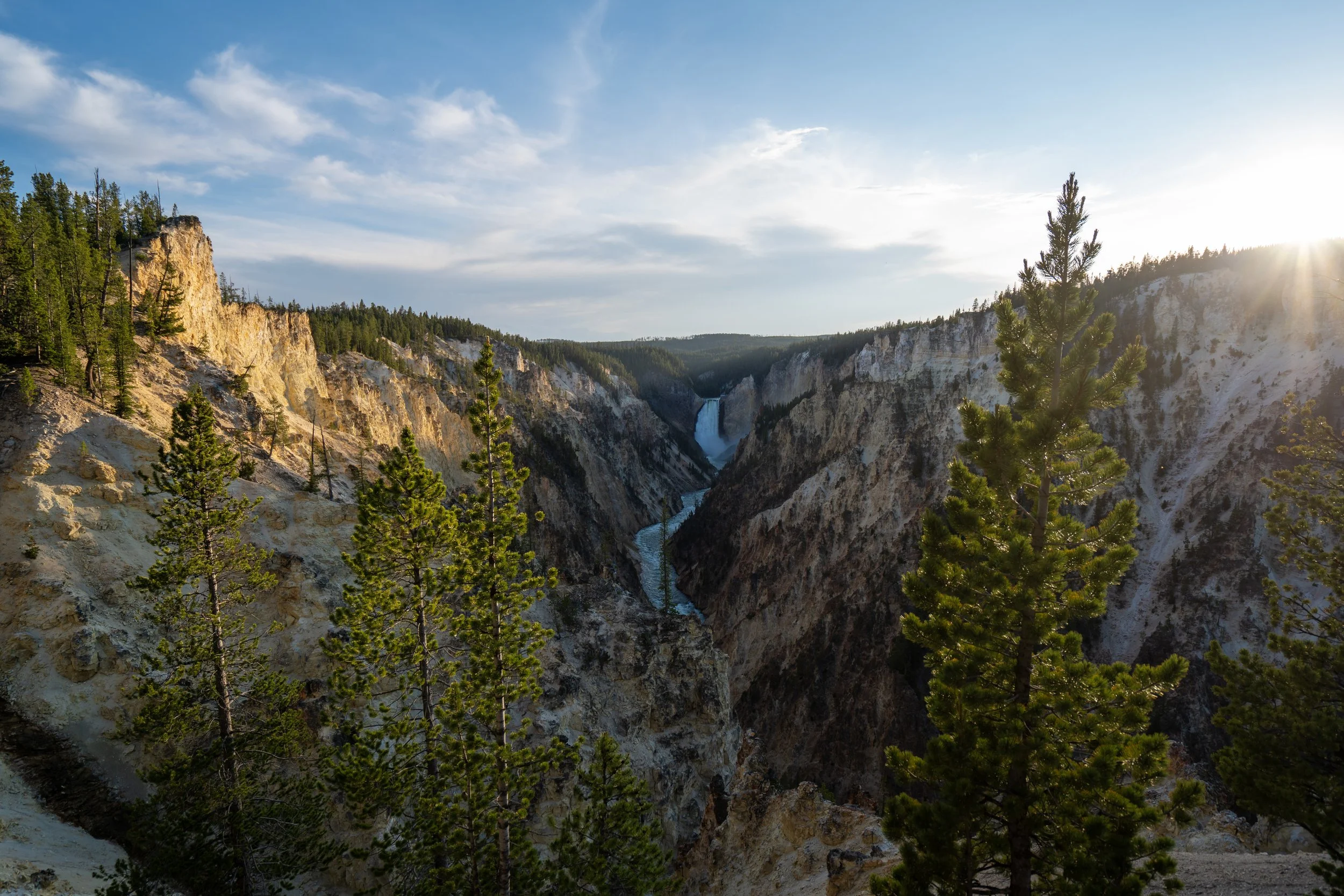
My Print - Artist Point (Grand Canyon of Yellowstone)
29. Brink of the Lower Falls Trail
Distance (Roundtrip): 0.7 miles / 1.1 km
Elevation Change: ~600 ft. / 183 m
The Brink of the Lower Falls Trail is a very short but steep day hike along the North Rim of the Yellowstone River that leads down to a beautiful, one-of-a-kind viewpoint right at the point where Lower Yellowstone Falls drops 308 ft. (94 m) into the canyon!
That said, the trail is only about 0.35 miles (0.6 km) each way, but it descends a series of very steep switchbacks, meaning it’s definitely not a trail for all visitors of all abilities.
However, if you think you’re up for the challenge, consider bringing trekking poles for this and countless other beautiful day hikes I have on this list, because I could not recommend making your way down to the Brink of the Lower Falls more!
Read My Separate Post: Brink of the Lower Falls Trail
30. Tower Falls Trail (Tower-Roosevelt)
Distance (RT to Yellowstone River): 0.9 miles / 1.4 km
Elevation Change: ~275 ft. / 84 m
The Tower Falls Trail is a beautiful day hike near Tower Junction that leads to both an overlook of the 132-ft. (40 m) Tower Falls and the Yellowstone River, where visitors can hike around and even fish along a 0.2-mile (0.3 km) stretch at the very bottom!
Before visiting, it’s worth noting that there is no maintained trail to the base of Tower Falls, which is arguably the biggest appeal of visiting Tower–Roosevelt, other than the amazing huckleberry ice cream inside the general store!
All jokes aside, there is quite a bit to know about the historic route that once led visitors to the bottom of Tower Falls, which I highly recommend learning all about in my separate article linked below!
Read My Separate Post: Tower Falls Trail
31. Bunsen Peak Trail
Distance: 4.2 miles / 6.8 km
Elevation Gain: ~1,300 ft. / 396 m
The Bunsen Peak Trail near Mammoth Hot Springs on the north side of Yellowstone is what I see as a hidden gem next to the busy thermal area just down the road, and like many day hikes in Yellowstone, Bunsen Peak also feels like two hikes in one when combined with the Osprey Falls Trail on the east side of the peak!
Now, all this goes without mentioning that my personal favorite thing about Bunsen Peak is the stunning, panoramic views of Lamar Valley to the north, which is arguably the biggest hotspot for spotting wildlife in Yellowstone National Park!
All that aside, I prefer Bunsen Peak as a late evening or even a sunset hike, which I say because this time of day not only makes for a much cooler hike up to the summit, but also because the beautiful views from the top are much better when the light isn’t so harsh on the surrounding landscape as it is during the midday hours.
Read My Separate Post: Bunsen Peak Trail
32. Yellowstone E-Bike Tour (Bunsen Peak)
This one-of-a-kind e-bike tour out of Gardner, Montana, is a fun and beautiful way to explore what I often consider to be one of the most beautiful parts of Yellowstone National Park, specifically the Swan Lake Flats and the areas surrounding Bunsen Peak and Mammoth Hot Springs!
I say this because this area just south of Mammoth has so many stunning, wide-open places to see, which is exactly what the tour focuses on!
Some of these include riding through the Golden Gate, exploring Osprey Falls, and circling around the base of Bunsen Peak, and the best part is that there’s no hassle transporting the e-bikes to and from the park, as the company will meet you inside of Yellowstone!
33. Mammoth Hot Springs
Mammoth is the northern gateway into Yellowstone National Park because, when flying into Bozeman to begin a Yellowstone–Grand Teton vacation, the North Entrance via Gardiner, Montana, and down into Mammoth is the way most visitors enter the park.
That said, Mammoth Hot Springs specifically is a very unique thermal area compared to most of the larger geyser basins to the south, in that the springs and pools pour out of a steep mountainside and ultimately cascade down the cliffs in a number of different, unique ways.
On a different note, I think it’s important to mention that Gardiner, Montana, just across the park boundary, is a great place to stay near the park, as all the best restaurants and hotels are only a 15-minute drive from Mammoth Hot Springs!
Google Maps Directions: Mammoth Hot Springs
34. Lamar Valley Wildlife Tours
There are a number of little hidden gems across Yellowstone National Park when it comes to trying to see wildlife, but among them all, Lamar Valley is widely considered the biggest hotspot for spotting Grizzlies, Wolves, Elk, and so much more! It’s certainly not called the 'Serengeti of Yellowstone' for no reason!
While the location itself certainly isn’t as simple as the Google Maps pin linked below, Lamar Valley is much more about the guided wildlife tours, because the guides who do this every day know inside information that the general public simply wouldn’t, such as where a recent carcass has been spotted.
That said, there is too much to cover in just a few sentences here, which is why I recommend checking out my tips at the very end, as there is a lot more to know about spotting wildlife than simply suggesting the long 18.1-mile (29.1 km) drive between Mammoth and the Tower–Roosevelt Junction.
Google Maps Directions: Lamar Valley

My Print - Lamar Valley
35. Yellowstone Private Tour
I get it! Yellowstone can feel like an overwhelming National Park, and it’s one of the most difficult parks in the country to feel like you’ve really seen it! This long list of experiences didn’t become what it is today without many years of repeat visits to America’s oldest National Park, and I’m still planning future trips because there’s truly so much to see!
I write all this because it’s completely understandable if you’re not comfortable hiking in Grizzly country for the first time. Trust me, it takes some getting used to, and it’s still something I’ll likely never feel completely okay with, even after countless encounters.
If any of this resonates with you, I highly recommend booking a private tour, and know that one of the best things about these tours is that they offer a variety of pickup locations in all the major towns around the park, which hopefully helps make them very convenient no matter where you plan on staying!
Additionally, I’ve included these tours because adventuring alone in Grizzly country, might not be the way you want to go. In this case, the tour options that I’ve listed provide a safe and amazing way to experience the Yellowstone–Teton area, and they offer the opportunity to discover nearby adventures that you may not have heard of otherwise!
Yellowstone Planning Advice
The one thing that I can say for sure is that Yellowstone is a huge National Park, and it takes many visits in all different seasons to truly appreciate how much there is to see and do!
That said, trying to see and do everything that I have on this list is a more than ambitious itinerary for a few days in Yellowstone. However, if you plan for at least 3-5 days within the park, you’ll get to see and do a lot of the best things that Yellowstone has to offer!
10 Best Things to Do Near Yellowstone National Park
Don’t forget to look beyond the park!
Yellowstone is amazing, but there are tons of equally amazing adventures and restaurants located within the greater Yellowstone-Teton area and beyond!
1. Grand Teton National Park
In northwest Wyoming, both Yellowstone National Park and Grand Teton National Park are seemingly synonymous and are often paired together into one roadtrip.
In fact, it’s only a 1-hour, 50-minute drive from Old Faithful to the Jenny Lake Visitor Center in the heart of Grand Teton National Park.
This is why, if you enjoyed reading everything I’ve written about Yellowstone, I recommend checking out my separate article about Grand Teton National Park, where I share the same inside information about everything there is to see and do on all sides of the park.
Read My Separate Post: Grand Teton National Park
2. Beartooth Highway
Soaring to an elevation of 10,947 ft. (3,337 m) at Beartooth Pass, the Beartooth Highway is easily one the best and most beautiful scenic drives on the planet, especially if you have the opportunity to hike around the pass at golden hour!
That said, the Beartooth Highway is rarely a convenient drive, whether coming to or from Yellowstone, but I can confidently say that it’s absolutely worth the detour, regardless of the time it adds to your drive!
Google Maps Directions: Beartooth Highway
3. Wind Cave National Park
In this part of the country, Yellowstone National Park and Grand Teton National Park, are most often combined with a roadtrip across Wyoming to visit both Wind Cave National Park and Badlands National Park in the Black Hills of western South Dakota. The drive from the East Entrance near Sylvan Pass, west of Cody, WY, to the Wind Cave Visitor Center is roughly 7 hours and 20 minutes, which really isn’t all that bad, considering most people make the long drive across Wyoming starting from Devils Tower, not Yellowstone or Wind Cave.
That said, I’ve also spent quite a bit of time exploring Wind Cave National Park over numerous seasons, which is why, if you enjoyed reading everything I’ve written about Yellowstone, I recommend checking out my separate article about Wind Cave, where I share the same inside information about everything there is to see and do on all sides of the park!
Read My Separate Post: Wind Cave National Park
4. Badlands National Park
Just as Grand Teton is to Yellowstone, so is Badlands National Park to Wind Cave!
This is why I simply can’t highlight Wind Cave National Park without talking about the Badlands just down the road, as I have spent equally as much time exploring the ins and outs of Badlands National Park, highlighting the best overlooks and trails and diving into detail about the best times of day to visit each!
All that to say, it’s only a 2-hour, 20-minute drive from the Wind Cave Visitor Center to the Pinnacles Entrance Station, just south of Wall and I-90. If you’re already coming from the east to visit Yellowstone, I recommend checking out my separate articles to learn more about both of South Dakota’s beautiful National Parks, including a separate deep dive I’ve written about the best things to do in the Black Hills!
Read My Separate Post: Badlands National Park
5. Coffee Factory Roasters (Red Lodge, MT)
Coffee Factory Roasters is a little-known coffee shop in Red Lodge, Montana, the gateway town to the scenic Beartooth Highway and Yellowstone National Park via Cooke City.
That said, I’ve included Coffee Factory Roasters on this list for two reasons.
The first is that it has long been one of my favorite local coffee shops I’ve ever found while road-tripping this beautiful country, but second, and perhaps more importantly, Red Lodge really isn’t all that out of the way, considering the Beartooth Highway is truly a must-see!
This is why, if you’re flying in or out of Billings or Bozeman, I recommend stopping in at either the beginning or end of your trip. However, if you are planning an early-season trip to Yellowstone (early June), be sure to check that the Beartooth Highway has opened for the season, as it can vary from year to year.
Yelp: Coffee Factory Roasters
6. Sacred Rim Trail
Distance: 3.7 miles / 6.0 km
The Sacred Rim Trail in Pinedale, Wyoming—about a 1-hour, 30-minute drive south of Jackson—is arguably the best day hike outside of both Yellowstone and Grand Teton National Park!
On top of this, the beautiful little town of Pinedale is worth the visit on its own, as the little downtown strip has great food, great coffee, fun small-town nightlife, and an outdoor shop that certainly rivals REI in Jackson!
This is all to say that the Sacred Rim Trail in the Wind River Range is an adventure worth going out of the way for! I would even go as far as to say that Sacred Rim is the best day hike across the entire Wind River Range—and yet, so few people actually go out of their way to hike this spectacular hidden gem!
Read My Separate Post: Sacred Rim Trail
7. Thai Thai Restaurant (Cody, WY)
There’s surely no shortage of American dining options in this part of the country, which is why I wanted to highlight Thai Thai Restaurant in Cody, Wyoming.
I say this because, if you’re looking for something a little different and a little healthier, I recommend stopping in at Thai Thai, as it really is a great place to switch it up, considering almost every option sold in Yellowstone National Park is something with a side of fries.
Yelp: Thai Thai Restaurant
8. Gannett Peak: The Highest Peak in Wyoming
Distance: 44.3 miles / 71.3 km
Contrary to popular belief, the Grand Teton in Grand Teton National Park is not the highest peak in Wyoming!
Rather, that title goes to Gannett Peak, which is widely considered to be the most remote state high point in the lower 48 and potentially the most difficult, rivaled only by Granite Peak in the Beartooth Mountains of Montana, just to the north of Yellowstone National Park.
I write all this because, if you think of yourself as someone who enjoys backcountry hiking and mountaineering, Gannett Peak may be the adventure for you!
However, if not, the simple backpacking trip into Titcomb Basin is worth the effort alone, as the basin sits beneath a number of stunning, towering, glaciated peaks and contains a number of beautiful lakes for backcountry fishing!
For all these reasons, the hike into Titcomb Basin is truly an adventure worth considering—especially if you were already looking for a fun, multi-day adventure near both Yellowstone and Grand Teton National Park!
Read My Separate Post: Gannett Peak via Titcomb Basin
9. Bear Creek Overlook Trail
Distance: 5.2 miles / 8.4 km
When talking about everything surrounding Yellowstone, Grand Teton, Jackson, and Pinedale, the Bear Creek Overlook Trail is a bit of the odd one out, as it’s easily the most inconvenient to everything discussed in this article.
However, the reason I included the Bear Creek Overlook on this list is because it has long stood as one of my top five favorite hikes I’ve ever done! Therefore, I’m not kidding when I say: go out of your way to hike the Bear Creek Overlook Trail—and know that it really isn’t all that big of a stretch if you’re already flying into Bozeman or planning to visit Glacier National Park on the same trip!
Read My Separate Post: Bear Creek Overlook Trail
10. Outlaw’s Pizza (Gardiner, MT)
Outlaw’s Pizza in Gardiner, Montana, is my favorite pizza spot on all sides of Yellowstone National Park, and I recommend stopping in after spending some time in Mammoth Hot Springs, Lamar Valley, or even climbing Bunsen Peak for sunset, as it really is a great place to sit down, enjoy a cold beer, and order some amazing pizza at a reasonable price!
Yelp: Outlaw’s Pizza
10 Things to Know Before Visiting Yellowstone National Park
1. Other than Lamar Valley and Sylvan Pass, don’t go out of your way to look for wildlife.
I say this because, without much effort, you will have tons of opportunities to see a variety of wildlife by simply driving across the park, as everything from Grizzlies, Black Bears, Wolves, Elk, Bison, Otters, and more can often be seen right off the main park roads!
To this point, traffic jams in Yellowstone usually mean wildlife, and while they can be a great place to grab a photo, do your best to park off the road, keep traffic moving, and maintain a safe distance.
The National Park Service has discussed in detail what constitutes a safe distance from each species.
2. Don’t try too hard to time an Old Faithful eruption.
When you first arrive at Old Faithful, you’ll likely want to see it erupt right away, but what most people don’t realize until later in the day is that you’ll probably see it go off at least 3-4 times over the course of your visit, simply by exploring the Upper Geyser Basin.
If you are ever wondering what time Old Faithful will erupt next, simply walk into one of the many buildings surrounding the geyser and it will always be posted in some form, like the clock in the photo below.
3. Walk the boardwalks early or late in the day.
I’ve highlighted again and again how busy the Upper Geyser Basin in Yellowstone truly is, which is why setting out on the trail either early or late can be a great way to avoid the majority of the crowds.
However, the more important reason may be that the boardwalks have hardly any shade, meaning that during the best and most beautiful summer travel months, exploring Yellowstone’s geothermal areas can be very hot and exposed!

My Print - Old Faithful Inn
4. Buy bear spray before visiting Yellowstone National Park.
When hiking in Grizzly country, having bear spray is not a suggestion—it’s a requirement!
That said, buying bear spray ahead of visiting Yellowstone National Park is the cheapest and most practical way to go because renting bear spray from one of the concessioners in or around the park is a bit of a scam.
I say this because if you’re planning more than a three-day trip to the Yellowstone–Teton area, then buying bear spray makes much more financial sense than renting.
If you are flying in, know that bear spray cannot be taken on board in your carry-on or checked luggage, but what I recommend instead is shipping bear spray to a nearby Amazon Locker ahead of your arrival at the airport.
5. The mosquitoes in Wyoming are worse than you think.
During the best and most beautiful summer months, the mosquito is pretty much the state bird in Wyoming!
By this, I mean that in lower-elevation areas around sunset—like the geyser basins and some campgrounds—they can be quite horrible. Not to mention, they are even a bit annoying on the Lone Star Geyser Trail at midday.
This is why I highly recommend buying this cheap bug net before visiting—especially if you plan to do any hiking, camping, or photography within or around the Yellowstone–Teton area.
6. Don’t throw coins or any objects into the thermal features.
It’s a shame to have to even write this, but please don’t be part of the problem!
That said, park rangers walk the boardwalks often, and if they see you intentionally putting anything into one of the thermal features, you will be pulled aside and fined—and rightfully so!
7. The best overnight backpacking trips are mostly outside of Yellowstone National Park.
I hope this long article shows just how much I love Yellowstone National Park, but as much as I love America’s first National Park, I, for a few reasons, don’t believe the backcountry trails within the park boundary compare to those around it.
The first is that the vast majority of Yellowstone is at a fairly low elevation in terms of an alpine environment, and as a result, the vast stretches of forest, rivers, and marshes across the park are a haven for mosquitoes—even under the midday sun!
However, the mountain ranges that surround Yellowstone—specifically the Beartooth Mountains to the north, the Teton Range to the south, and the Wind River Range south of Jackson—are all better and more beautiful places to get into the backcountry compared to Yellowstone.
One great adventure to consider should be The Beaten Path in the Beartooth Mountains just to the north, but this is truly just one of countless options to keep in mind.

My Print - Beartooth Mountains
8. The general stores in Yellowstone National Park are very consistent.
General Stores are generally found at all the busy villages within Yellowstone National Park, and if thing is true, one will very closely resemble another just down the road.
That said, I don’t think consistency is a bad thing because wherever you might be, a General Store in Yellowstone can be a great place to grab souvenirs, quick snacks, camping supplies, and, most of all, Wilcoxson’s famous huckleberry ice cream!
9. Be mindful of where you step.
Yellowstone is home to one venomous snake, the Prairie Rattlesnake.
In addition, there are three native plants within Yellowstone National Park that are endemic to the park, meaning they are found nowhere else on Earth.
The three species are the Yellowstone Sulphur Flower (Eriogonum umbellatum var. cladophorum), Ross’s Bentgrass (Agrostis rossiae), and the Yellowstone Sand Verbena (Abronia ammophila).
I write this to say, please do your part to minimize your impact, both on and off the trail.
10. The best towns to stay near the park are Cody, West Yellowstone, and Gardiner.
When planning a trip and considering drive times, I recommend trying to be flexible.
I say this because some places, like the Upper Geyser Basin and Yellowstone Lake, can be hard to plan exactly how long it will take to see, considering all there is to try and fit in.
This is why I recommend keeping these three towns in mind when looking for lodging outside of Yellowstone National Park. However, understand that two of the three will likely be very impractical to drive to, depending on exactly what part of Yellowstone you plan to see on any given day.
Above all else, don’t consider Jackson as an option. It’s too far away away from the park to make the roundtrip drive worth it.
Search Hotels: Cody, WY / West Yellowstone, MT / Gardiner, MT
Yellowstone National Park