
20 Best Things to Do in Great Basin National Park
From towering peaks, the oldest trees on Earth, plants and animals not found anywhere else, and the only glacier in the State of Nevada, Great Basin National Park is a beautiful and unique 'Sky Island' in the truest sense—surrounded by one of the harshest deserts on all sides!
By this, I mean that Great Basin National Park—or, rather, the Snake Range—is a high-elevation mountain range that towers at just over 13,000 ft. (3,962 m) atop Wheeler Peak. What this really means is that, regardless of the surrounding desert, Great Basin National Park acts like an island, offering visitors beautiful forests, alpine lakes, and typically very comfortable summer temperatures, as many of the park’s trails climb to or begin above 10,000 ft. (3,048 m)!
However, this all goes without saying that Great Basin National Park is pretty much next to nothing in terms of being convenient to get to. It’s a few hours away from both Las Vegas and St. George to the south, and even farther from Reno to the west, which is why travelers shouldn’t expect to find much in the way of accommodations when making it out to Baker—the gateway to Great Basin National Park.
All that aside, its rugged and remote beauty is what makes Great Basin National Park special to see, which is me really saying that it’s a hiking destination above all else. This is why I highly recommend coming to Great Basin National Park with the expectation to set out on a number of different hikes, as many of the best things to do are only accessible by trail!
What is the Best Time of Year to Visit Great Basin National Park?
Great Basin National Park is a very high-elevation landscape, hence the reason it’s often referred to as an 'Island in the Sky.'
That said, many of the best things to see and do are all located well above 10,000 ft. (3,048 m), even if certain trailheads are located below this benchmark.
I write all this to say that Wheeler Peak Scenic Drive, the most popular road in the park, is not open year-round, as it’s typically cleared of its seasonal snowpack by Memorial Day and stays open through early November.
This means that the best time to visit Great Basin National Park is obviously during the warmer summer months, but from experience, I personally think the best time of year is a little more nuanced.
By this, I mean that there are two things to consider. The first is that hiking to the alpine lakes—such as those off the Alpine Lakes Loop Trail, or even Johnson Lake, Dead Lake, and Baker Lake—are some of the best things to do in Great Basin National Park. However, all the lakes in the Snake Range are fed by snowmelt, meaning that, in the mid- to late-summer months, they dry up considerably compared with how beautiful they often are in May and June. In fact, both Stella and Teresa Lake, two of the most popular, often look like small alpine tarns rather than lakes come August.
This is why one answer regarding the best time of year to visit is mid-June, when much of the snow has melted off the trails, but the lakes are still full!
Alternatively, Great Basin National Park is home to vast stretches of Aspen forests, and as a result, visiting during peak fall colors is somewhat of a hidden gem—not to mention, the typically quiet National Park is even quieter when the kids are back in school!
Peak fall colors in Great Basin typically occur around the middle of September for the upper elevations above 9,000 ft. (2,743 m) and into early October for the lower-elevation trees as far down as Baker Creek.
All this to say, I truly think it’s a toss-up when trying to pinpoint the best time of year to visit Great Basin National Park, but as long as Wheeler Peak Scenic Drive is open for the season, there’s always something fun to do!
Hiking Checklist - Great Basin
Obviously, for camping, you will need general backpacking gear. For this reason, I wrote a separate post about what backpacking gear is worth the money, from my experience, and what the best alternatives are to save you money.
Read My Separate Post: Best Ultralight Backpacking Gear
In addition, here is a complete list of must-have things that you will want for any hike in Great Basin National Park.
20 Best Things to Do in Great Basin National Park
The following list is written in no particular order of best or worst.
However, it’s important to come prepared for the time of year you’ll be visiting, considering that Great Basin National Park is a very high-elevation park and many of the best things to do are located above 10,000 ft. (3,048 m).
This means it’s important to prepare for snow and ice in the spring and early summer, as well as for hot summer temperatures at the lower elevations in July and August.
1. Wheeler Peak Summit Trail
Distance: 8.6 miles / 13.8 km
Elevation Gain: 2,883 ft. / 879 m
Standing at an elevation of 13,063 ft. (3,982 m), Wheeler Peak towers above the seemingly endless desert that surrounds the Snake Range as not only the tallest mountain in Great Basin National Park, but also the tallest summit located entirely within the State of Nevada!
The mountain is home to some of the oldest trees on Earth, Nevada’s only glacier, and pristine alpine lakes located in the glacial cirque beneath the peak—which is exactly where the next few recommendations on this list come from!
For all these reasons, Wheeler Peak is one of the most sought-after day hikes in Great Basin National Park, which I highly recommend learning more about in my separate article linked below, as there is a lot to know before setting off—particularly when it comes to choosing which trailhead to begin hiking!
Read My Separate Post: Wheeler Peak Summit Trail
2. Glacier Trail
Distance (One Way to Exposed Glacier): 2.5 miles / 4.0 km
I may be biased, but I believe the Glacier Trail is the best day hike in Great Basin National Park!
I say this because the Glacier Trail not only traverses Nevada’s only glacier, but this beautiful 2.5-mile (4.0 km) out-and-back day hike also combines the ancient Wheeler Peak Bristlecone Grove into one adventure!
That said, the best part of the entire Glacier Trail is the exposed glacier at the very end of the glacial cirque. However, the maintained trail stops well short of the point shown in the photo below.
This means that visitors must hike off-trail to reach the best and most beautiful part of the entire hike, which I encourage you to learn more about in my separate post linked below, as there is one best route that requires the least amount of effort to reach the glacier!
Read My Separate Post: Glacier Trail
3. Bristlecone Trail
Distance (RT on Bristlecone Trail Only): 2.8 miles / 4.5 km
It’s certainly not fair to talk about the Glacier Trail without also discussing the Bristlecone Interpretive Loop Trail, as the two are seemingly synonymous and often treated as one day hike, much like The Narrows is an extension of the Riverside Walk in Zion National Park.
That said, I wanted to highlight the Bristlecone Trail separately from the Glacier Trail because, if you don’t plan to hike off-trail to reach the exposed Wheeler Peak Glacier in the deepest parts of the cirque, the much shorter Bristlecone Pine Loop is worth the effort alone!
Read My Separate Post: Bristlecone Trail
4. Great Basin Café Milkshakes
The Great Basin Café is the only place to get food inside Great Basin National Park, but out of everything they serve, their milkshakes deserve their own place on this list!
I mean it when I say, they really are that good, and nothing is quite as good as stopping in for an afternoon milkshake after a fun day out on one of the park’s many beautiful the trails, like the Snake Creek Overlook Trail!
Yelp: Great Basin Café
5. Lehman Caves Tour
Lehman Cave is a beautiful 2.0-mile (3.2 km) cave in the foothills of Great Basin National Park, and while much shorter than that in Wind Cave National Park, it the longest-known cave in the State of Nevada!
That said, there are five main guided cave tours in Great Basin National Park that visitors can enjoy!
They are the Gothic Palace Tour, the Lodge Room Tour, the Grand Palace Tour, the Introduction to Wild Caving Tour, and the First Room Accessible Tour, summaries of which can all be found on the Recreation.gov booking page linked below.
All that to say, I highly recommend taking the time to book one or more cave tours if you’re visiting Great Basin for the first time, but be sure to plan a few weeks in advance, as reservations for the most popular tours tend to sell out early!
Book Here: Lehman Caves Tours
6. Mountain View Nature Trail
Distance: 0.4 miles / 0.6 km
The Mountain View Nature Trail is a very short and easy loop trail that begins at the Lehman Caves Visitor Center, and it’s one that I believe is among the best things to do in Great Basin National Park because hiking the trail is the only way to see the Lehman Cave Natural Entrance—the historical entrance that was first used before the modern-day tunnels were constructed to give visitors much easier access to the cave!
The reason I’ve listed the Mountain View Nature Trail immediately after the Lehman Caves tours is that I believe the short loop is a great hike either before or just after a scheduled cave tour, as it truly takes very little time to hike and enjoy the best of all there is to see!
Read My Separate Post:Mountain View Nature Trail
7. Alpine Lakes Loop Trail
Distance: 2.7 miles / 4.3 km
There aren’t a lot in terms of natural alpine lakes across the Snake Range, but both Stella Lake and Teresa Lake, off the Alpine Lakes Loop Trail, are easily the two best and most accessible lakes in Great Basin National Park!
Additionally, the relatively easy loop to both lakes is often combined with the Bristlecone and Glacier Trail, as well as the Wheeler Peak Summit Trail, making the whole area a great place to spend a long day in the outside!
Read My Separate Post: Alpine Lakes Loop Trail
8. Upper & Lower Lehman Creek Campground
Both the Upper and Lower Lehman Creek Campgrounds are two of the most beautiful front-country campgrounds in Great Basin National Park!
That said, there isn’t a lot in terms of lodging or other services in Baker near the park, which really means all the drive-up campsites off Wheeler Peak Scenic Drive are very popular during the summer travel season.
This is why it’s important to reserve your campsite as soon as you know your dates, which can either be done directly through the Recreation.gov widget below or by clicking the links.
Book Here: Upper Lehman / Lower Lehman
No information is collected by this website when using the Recreation.gov booking widget, and all reservations made here are secure through the official website.
9. Mather Overlook (Sunrise)
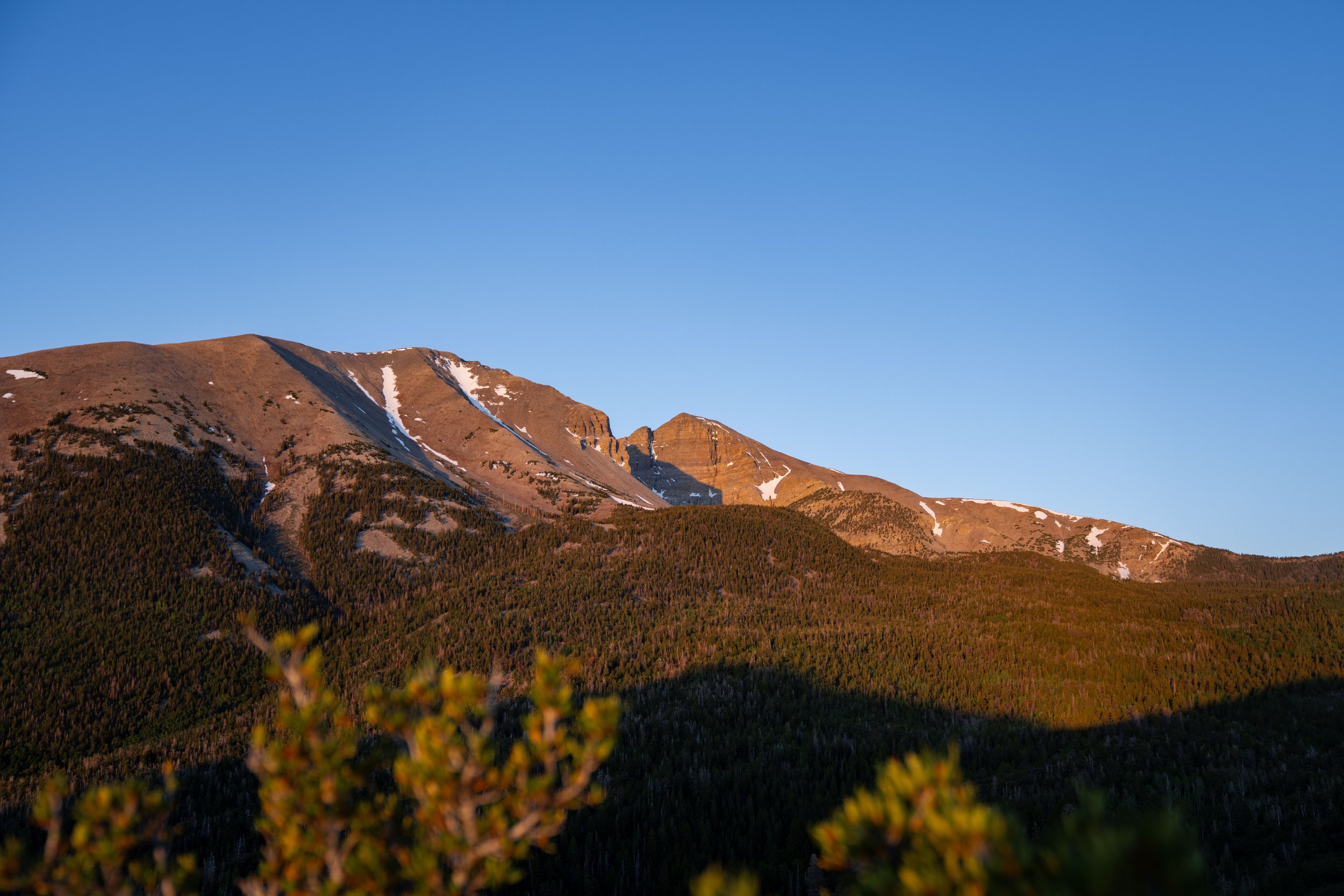
Mather Overlook is a beautiful drive-up viewpoint off Wheeler Peak Scenic Drive that, in my opinion, is the best scenic overlook for watching the sunrise in Great Basin National Park!
I say this not because Mather Overlook has a great view of the sunrise itself, but because the southwest-facing viewpoint is perfectly situated on the east side of the Snake Range to watch the beautiful alpenglow work its way down Wheeler Peak, the highest peak in the park!
Google Maps Directions: Mather Overlook
My Print - Mather Overlook (Sunrise)
10. Wheeler Peak Scenic Drive
If you have time for nothing else when passing through this quiet, forgotten little corner of the country, make time to drive the 11.7-mile (18.8 km) Wheeler Peak Scenic Drive!
I say this because the entire road takes only about 20–25 minutes each way, and there are beautiful drive-up overlooks, including the Mather Overlook mentioned above and the Wheeler Peak Overlook mentioned below, which is the only viewpoint on the road to see the Wheeler Peak Glacier at the end of the Glacier Trail!
Either way, many of the best things in Great Basin are all located along this short, out-and-back drive, which is why I highly recommend spending a little time to check out the sights—especially considering that Great Basin National Park does not charge an entrance fee!
Google Maps Directions: Wheeler Peak Scenic Drive
11. Grey Cliffs Campground
Grey Cliffs Campground is the most beautiful drive-up campground outside of those along Wheeler Peak Scenic Drive, and the best part is that it’s only minutes away from the Lehman Caves Visitor Center, the road down into Baker, and all the best things to do in Great Basin off the scenic summit road!
That said, I personally like Grey Cliffs Campground because it’s a little less competitive than both Upper and Lower Lehman Creek, while still having Baker Creek running right through it, which makes for a great place to cool off during the warmer summer months.
Book Here: Grey Cliffs Campground
No information is collected by this website when using the Recreation.gov booking widget, and all reservations made here are secure through the official website.
12. Lexington Arch Trail
Distance: 5.6 miles / 9.0 km
The Lexington Arch Trail is a really cool hike! There’s not a more elegant way to say it!
However, that goes without mentioning that the Lexington Arch Trail is a bit out of the way compared to every other adventure in Great Basin, as it’s the only trail at the very end of the long out-and-back drive off the highway.
In comparison, both the Snake Creek Trailhead and the Baker Creek Trailhead serve a number of different adventures, making them a great place to combine a bunch of hikes into one over a long day.
Nevertheless, the Lexington Arch Trail is absolutely worth going out of the way for, as the hike isn’t all that challenging, and the towering arch is much bigger in person than photos from any angle make it appear!
Read My Separate Post: Lexington Arch Trail
13. Sky Island Forest Trail
Distance: 0.4 miles / 0.6 km
The Sky Island Forest Trail is a very short and easy loop off the Alpine Lakes Loop, where visitors can learn about why Great Basin—or, more specifically, the Snake Range—is commonly referred to as an 'Island in the Sky.'
The short loop can easily be added to other day hikes that begin from the same trailhead, such as the Glacier Trail, but whether hiked individually or combined with another adventure, I recommend taking the time to slow down and read the signs, as there is no better place in the park to learn what makes Great Basin so unique!
On a side note, the Sky Island Forest Trail may be the best place to learn what the term 'Sky Island' means, but it is not the best place to see it. Instead, I recommend hiking the Osceola Ditch Trail off Wheeler Peak Scenic Drive, which provides a much better visual contrast between the beautiful, high-elevation forests of the Snake Range and the vast, harsh desert stretching as far as the eye can see just a few miles outside of the park.
Read My Separate Post: Sky Island Forest Trail
14. Baker Lake & Johnson Lake Trails
Distance (Johnson Lake): 7.8 miles / 12.6 km
Distance (Baker Lake): 11.6 miles / 18.7 km
Both Baker Lake and Johnson Lake are two beautiful alpine lakes located high in the backcountry of Great Basin National Park!
The reason I listed two trails under one recommendation is that, if you’re visiting Great Basin for the first time, it’s likely that you’ll only make it to one or the other.
However, the two are commonly linked together, both as a longer day hike and as a multi-day backcountry trip, utilizing the connector up the west side of Pyramid Peak, as well as the Timber Creek Trail, to cross the Snake Creek Divide.
In any case, I think I’d be splitting hairs if I were to try and say which is the better of the two. However, when Baker Lake is at or near its maximum depth in late spring and early summer, it is my overall recommendation if you’re trying to decide which of the two to prioritize!
Read My Separate Post: Baker Lake Trail / Johnson Lake Trail
15. Wheeler Peak Overlook
Wheeler Peak Overlook, on the north side of Wheeler Peak, is a great stop for two reasons!
First, it is one of the best drive-up viewpoints for watching the sunrise on Wheeler Peak, similar to how I described Mather Overlook above!
However, second—and perhaps more importantly—the Wheeler Peak Overlook is the only viewpoint off Wheeler Peak Scenic Drive where you can see the Wheeler Peak Glacier from the road!
This is significant because, if you don’t plan to hike the Glacier Trail or continue past the end of the maintained trail to reach the exposed glacier, as outlined in my separate article, then stopping at the Wheeler Peak Overlook is the next-best choice! Even from the first viewpoint on the rock glacier, the exposed glacier is more obstructed than it is from the Wheeler Peak Overlook shown here!
Google Maps Directions: Wheeler Peak Overlook
16. Snake Divide Trail (Magic Grove)
Distance (One Way to Mt. Washington): 6.3 miles / 10.1 km
Elevation Gain: 3,110 ft. / 948 m
The Snake Divide Trail is, without a doubt, the most challenging day hike on this list, but at the same time, it is easily one of the best things to do in Great Basin National Park!
That said, the long day hike up the Snake Divide Trail leads to one of the most beautiful, hidden Bristlecone Pine groves in Great Basin National Park and allows hikers the easy opportunity to continue just a little farther and summit Mt. Washington!
I use the word "easy" because the most difficult part of the Snake Divide Trail is everything leading up to Magic Grove, meaning that adding Mt. Washington to the hike really is one of the easier parts of the long adventure.
With all that in mind, I could not recommend making a day of the Snake Divide Trail more, as there’s truly nothing technical about the hike. It’s just a long, remote, all-uphill adventure and should be respected with proper planning, including plenty of food, water, and appropriate clothing for the high elevations above the tree line.
Read My Separate Post: Snake Divide Trail (Mt. Washington)
17. Wheeler Peak Campground
Wheeler Peak Campground is a beautiful, high-elevation campground located at just under 10,000 ft. (3,048 m) in the glacial cirque beneath Wheeler Peak!
For this reason, Wheeler Peak Campground is my favorite drive-up campground in Great Basin National Park, as the cooler temperatures, beautiful Aspen trees, and easy access to some of the best trails in the park easily set it apart from every other comparable campground during the best mid-summer months for visiting Great Basin!
Book Here: Wheeler Peak Campground
No information is collected by this website when using the Recreation.gov booking widget, and all reservations made here are secure through the official website.
18. Sage Steppe Loop Trail
Distance: 1.2 miles / 1.9 km
The Sage Steppe Loop Trail is a very short, easy day hike in the northern foothills that, at first glance, might seem like nothing more than a hot hike through a devastating burn scar. While some of that certainly holds some truth, the Sage Steppe Loop is a hidden gem for a more unsuspecting reason: the Bonneville Cutthroat Trout!
Yes, Strawberry Creek is one of the best habitats for spotting this elusive native species, as is Lehman Creek along the Lehman Creek Trail.
This is why, whether you’re a hiker, a fisher, or simply looking for a great place to trail run, I recommend considering the easy Sage Steppe Loop Trail, which circles some of the best parts of Strawberry Creek below the natural groundwater spring!
Read My Separate Post: Sage Steppe Loop Trail
19. Baker Creek Loop Trail
Distance: 3.5 miles / 5.6 km
The Baker Creek Loop Trail is an adventure that I believe is one of the best things to do in Great Basin National Park, and I say this for a number of reasons that all center around one specific reason: distance!
The first is that the Baker Creek Loop Trail is a great option for those looking to get out on less popular trails in the park without committing to something as long as the adjacent Pole Canyon Trail or as steep as the Serviceberry Loop Trail.
The second is that the Baker Creek Loop, in the lower foothills, traverses the same type of mixed forest–Sagebrush habitat as these longer adventures, meaning it allows you to enjoy the best of the Snake Range foothills without, again, hiking nearly as far as other similar options.
The last, and perhaps most important, reason is that the Baker Creek Loop Trail is one of the best day hikes for enjoying fall colors in Great Basin National Park without, for a third time, setting out on one of the much longer—and, yes, very similar—trails that traverse the same habitat.
Distance, shade, and elevation change are key here, which is why I believe the Baker Creek Loop is one of the best day hikes near the Lehman Caves Visitor Center!
Read My Separate Post: Baker Creek Loop Trail
20. Osceola Ditch Trail
Distance (RT from WPSD to SC Burn Scar): 4.4 miles / 7.1 km
The Osceola Ditch Trail is a unique day hike that follows the path of a historic, 18.0-mile (29 km), hand-dug ditch that was once used to divert water from the Snake Range to an old mining district in the foothills!
That said, I do not believe the Osceola Ditch Trail has to be hiked in its entirety to enjoy the best of what there is to see, including learning about the ditch from several signs along the trail and walking in the ditch itself.
The post linked below talks a lot about how the Osceola Ditch Trail has changed over the years, which largely means it has been shortened again and again from what it used to be. This is why my article about the trail only covers the section from Wheeler Peak Scenic Drive to the 2016 Strawberry Creek Fire burn scar, which is the only portion of the hike that is open today.
Read My Separate Post: Osceola Ditch Trail
10 Best Things to Do Near Great Basin National Park
The word "near" is very much a relative term when talking about the best things to do around Great Basin National Park, as everything in any direction is quite a long drive—even things as simple as looking for a nice place to sit down for dinner.
This is why I wrote this list broadly, as visiting Great Basin National Park inevitably means spending a lot of time in the car, though it really depends on which direction you’re coming from and where you plan to go after.
1. Zion National Park
When starting a trip in Las Vegas to visit Great Basin, Zion National Park is the closest and most practical destination in the opposite direction, especially during the cooler off-season months.
On that note, I have been visiting and revisiting Zion for many years, just as I have with Great Basin, which is why I believe the list I’ve created about the park truly offers the best tips and recommendations you will find—especially when it comes to hiking the Angels Landing Trail.
Read My Separate Post: Zion National Park
2. Loneliest Road in America (U.S. Highway 50)
In 1986, Life magazine called a U.S. Highway 50 across central Nevada, the "Loneliest Road in America!"
Well, needless to say, the name stuck, and decades later, U.S. Highway 50 across central and eastern Nevada still bears the name today!
That said, the Loneliest Road in America has more than a few beautiful towns and destinations along the way, including Sand Mountain east of Fallon, the Town of Austin, the Northern Railway Museum in Ely, and, of course, Great Basin National Park!
This is all to say that even though Reno is quite far from the park, there’s a lot to love about turning the drive to Great Basin into an adventure of its own!
Google Maps Directions: Loneliest Road in America (Austin, Nevada)
3. Nevada Northern Railway Museum
In downtown Ely, there’s a little-known National Historic Landmark known as the Nevada Northern Railway Museum, where visitors can book a number of different experiences to learn about the train depot, what it meant for the growing mining town of Ely in the early 1900s, and its role in supporting the region’s copper-mining industry and connecting the community with the rest of the country!
Before visiting, be aware that there are a lot of different tours worth considering, but one of the best things to do at the museum is to simply buy a ticket for a self-guided tour, as this grants visitors an up-close, hands-on experience and access to all the best parts of the museum—and know that I use the word museum loosely!
What I mean is that the Nevada Northern Railway Museum is really an active rail yard, and as such, it’s not a manicured experience that involves walking a paved path.
Rather, it’s the type of experience where you’ll want to wear good shoes, as you’ll be exploring historic buildings like the Roundhouse—also known as the Engine House—and the Machine Shop that are still in use today!
Google Maps Directions: Nevada Northern Railway Museum
4. Stargazer Inn & Bristlecone General Store
In Baker, Nevada, just outside of Great Basin National Park, there is but one store known as the Stargazer Inn & Bristlecone General Store, and it is the go-to staple for food, drinks, coffee, and gifts—and has been since it came under new ownership in the spring of 2022!
That is really to say, I have no doubt you’ll be in the general store at some point during your trip to Great Basin, as there really is nothing else around!
On that note, I recommend stopping in to sit down and talk. If you have any questions about the park, the trails, or any of my recommendations on this list, they’ll be happy to answer them!
P.S. Be sure to ask about their red—possibly orange—chair!
5. Mt. Whitney Trail (Highest Peak in California)
Distance (Roundtrip): 22.2 miles / 35.7 km
Elevation Gain: ~6,165 ft. / 1,879 m
Mt. Whitney via Whitney Portal, just outside of Lone Pine, is a roughly 6-hour, 35-minute drive from Baker, Nevada, just outside the park boundary.
That said, there’s nothing quite like climbing to the summit of Mt. Whitney, the highest summit in the lower 48 states!
However, there is quite a bit to know about the climb before visiting, including how to get a permit for the trail, considerations around day hiking vs. camping, and countless other details about the climb itself, which you can read all about in my very detailed separate article linked below.
Read My Separate Post: Mt. Whitney Trail (Lone Pine)
6. Lake Tahoe
If you’re starting your trip in Reno or driving west out of Great Basin toward Lone Pine, Mt. Whitney, or even Bishop, then adding Lake Tahoe to your drive really isn’t all that out of the way!
That said, South Lake Tahoe is only a 6-hour, 45-minute drive from Baker, Nevada, which isn’t all that bad considering everything in any direction of Great Basin is quite the long drive, though you get to add the Loneliest Road in America when connecting Great Basin with Lake Tahoe!
Read My Separate Post: Best Things to Do in Lake Tahoe
7. JT’s Steakhouse
This isn’t something I would normally say when writing recommendations about a National Park or a similar destination, but I felt that I struggled to find good food in Ely, west of the park, which is truly the only sizable town with options outside of Great Basin!
However, JT’s Steakhouse is by far the best place to eat in town, and I’m not just saying that because there aren’t many options. It really is a great place to sit down and enjoy a nice dinner!
Beyond this, there’s also La Fiesta for some good Mexican food right across the street, as well as Hometown Pizza down the road, which I like when I want leftovers for camping instead of making the long drive back and forth between the park and Ely just to get some food.
Yelp: JT’s Steakhouse
8. Death Valley National Park
Death Valley is not a park I recommend visiting during the beautiful, sunny summer season, but if you happen to be visiting Great Basin during the cooler spring or fall off-season months, Death Valley can be a great place to add to your list!
That said, Furnace Creek in Death Valley National Park is roughly 5 hours and 45 minutes away from Baker, as the long drive cuts straight across the heart of Nevada, much like U.S. 50 mentioned above.
However, I’d say the drive is well worth the effort, which can easily be planned in the fall if you’re already trying to see the beautiful changing Aspens in Great Basin at the same time!
Read My Separate Post: Death Valley National Park
9. Yosemite National Park
Yosemite National Park may seem a bit out of the way from Great Basin National Park, but if you’re flying to Reno to visit Great Basin, then Yosemite isn’t as out of the way as it may initially seem.
In fact, from the Reno Airport, Yosemite Village is only 4 hours and 25 minutes away when Tioga Pass is open.
To learn more, I’ve written an entirely separate post about Yosemite, similar to my detailed article about Great Basin.
Read My Separate Post: Yosemite National Park
10. Sequoia & Kings Canyon National Park
This recommendation should come as no surprise, as one of the most common California roadtrips is visiting all three National Narks in the Sierra Nevada at once.
For this reason, I want to highlight that Grant Grove in Kings Canyon National Park is only a 3-hour 30-minute drive from Yosemite Valley, and Giant Forest in Sequoia National Park is only 4 hours and 15 minutes away.
This is why, if you enjoyed reading everything I’ve written about Great Basin, I recommend checking out my separate article about both Sequoia and Kings Canyon National Park, where I share the same inside information about everything there is to see and do on all sides of each park.
Read My Separate Post: Sequoia & Kings Canyon National Park
3 Things to Know Before Visiting Great Basin National Park
1. Pack a cooler for a multi-day visit in Great Basin National Park.
The town of Ely is 62 miles (100 km) away from Baker, just outside Great Basin.
This means that, at a minimum, you’re looking at a 120-mile (193-km) roundtrip drive if you want to stay in one of the nicer hotels and get good food in Ely—and I think it’s important to stress the words "at a minimum" because this drive only gets longer depending on which trailhead you plan to visit.
With all that in mind, camping in and around Great Basin is the best way to avoid this long back-and-forth drive, and bringing a cooler is one of the best ways to make a multi-day visit much more comfortable and practical!
I recommend planning easy meals that can be cooked over a stove or a fire, but using one of the designated campgrounds within the park or camping on Bureau of Land Management (BLM) land just outside of the park boundary is one of the best ways to have a more enjoyable time in Great Basin!
2. Trails across Great Basin National Park have a lot of elevation change.
Not only do countless trailheads in Great Basin start above 7,000 and 8,000 ft. (2,133 and 2,438 m), but many also climb steep elevation gradients, gaining anywhere from 1,000 – 3,000 ft. (305 – 914 m)—sometimes more!
This is why I consistently recommend using trekking poles throughout my hiking articles, which can be particularly useful on adventures like the Wheeler Peak Summit Trail, the Glacier Trail, and the Snake Divide Trail to Magic Grove, all of which I could not recommend more!
3. Get gas before arriving in Great Basin National Park.
There is one small gas station in Baker, just outside the park, but it is very expensive compared to what you will find elsewhere.
This is why I only recommend filling up in Baker as a last resort.
On a different note, I also recommend getting gas as a safety precaution, as Nevada really is that big, and here’s a good story to back that up!
One morning, I was driving out of Ely for the Upper Strawberry Trail, with plans to hike off Wheeler Peak Scenic Drive after finishing. I left town with half a tank, which I believed was more than enough, given that I was driving a brand-new, fuel-efficient rental car from the airport in Reno.
Now, what I shouldn’t have been complacent about is the fact that Highway 50 between Ely and Baker crosses two mountain ranges. So, when I was done hiking and started making my way back to Ely late in the day, I noticed that I was going to be cutting it close on fuel, though the car’s fuel estimate still gave me about 15 miles (24 km) more than what the GPS said the drive was.
However, as the drive went on, this cushion quickly started to fade with each hill, and by the time I was descending the Schell Creek Range east of Ely, the rental car was alerting me that I was dangerously low on fuel, yet I still had about 18 miles (29 km) to go!
To end the story here, I made it with less than half a gallon in the tank, based on how much fuel the car took at the gas station in Ely. If I can say anything from all this, learn from me, and don’t get complacent! Use the expensive gas station in Baker if need be. It really is a safety issue!