

20 Best Things to Do in Zion National Park
From dramatic canyons and towering cliffs to scenic drives and endless climbing, Zion National Park is renowned for its breathtaking desert landscapes, hidden waterfalls and swimming holes, and world-class hiking trails, including some of the best and most popular adventures, like the Angels Landing Trail!
That said, Zion National Park is certainly just as beautiful as it is busy, as many of the most popular destinations are centered around the narrow and congested Zion Canyon.
This is why Zion National Park can and should be planned with the idea of visiting certain areas at certain times of the day and year—and yes, I mean year, because snow, ice, and summer heat will largely determine what’s open, what is safe, and whether waterfalls will be flowing.
All this to say, I’ve been fortunate to visit Zion National Park many times over many years—first when I was just a little kid—and across all those visits, in every season, I believe this list truly includes some of the best recommendations and insider tips that you will find about the park—regardless of the time of year you plan to visit!
What is the Best Time of Year to Visit Zion National Park?
In most U.S. National Parks, I generally believe there is one clear-cut answer to this question that is largely based on snow and when certain roads open and close for the season.
However, Zion National Park is open year-round, which is why answering this question is a bit more nuanced. I like to say, Zion is a place of many extremes, and winter snow, seasonal snowmelt, and summer heat all play important roles in answering this question.
This is why I think the best way to answer this question is to talk about Zion on a season-by-season basis.
Summer
If by 'best time of year' you mean the most accessible, then the answer is easily the warmer summer months. However, summer typically brings temperatures that soar well over 100 ºF (37.8 ºC), which can make hiking far too uncomfortable—not to mention dangerous!
On top of this, the waterfalls shown throughout this article will be dry during the summer unless there are heavy monsoonal storms in the area. That said, certain adventures—like The Narrows and the Observation Point Trail via East Mesa—are only accessible during the warmer, snow-free months, which is why I believe there isn’t one perfect answer to this question.
Winter
Snow in Zion National Park is nothing short of spectacular, but it can severely limit your ability to explore the park. Specifically, roads like Kolob Terrace Road and Lava Point Road are only plowed to a certain point, and snow and ice on exposed trails—like The Chains leading up to Angels Landing—can often make hiking steep, exposed trails far too dangerous for most hikers.
However, I would never let snowy winter conditions discourage a visit to Zion National Park because simple, lower-elevation trails, like the Watchman Trail, can be even more beautiful when the high-elevation peaks are covered under a blanket of snow!
Spring
Spring in Zion National Park is always a toss-up regarding the winter snowpack and when certain things will open for the season based on snowmelt.
By this, I mean that the uppermost elevations often hold snow through mid-April, with conditions improving rapidly by early May before the warmest summer months.
During this time, The Narrows typically closes because the Virgin River exceeds the safety threshold of 150 CFS (4.25 m³/s). At the same time, all this melting snow creates waterfalls across Zion that are otherwise dry throughout most of the year.
The last thing to highlight when talking about spring is that snowmelt during the day often leads to black ice when temperatures dip below freezing overnight, and the park’s dramatic elevation gradients play a large role in what conditions will look like on different parts of a trail. This might mean that the beginning of the Angels Landing Trail does not have black ice, but the uppermost elevations, where it is most dangerous, might be very slippery.
That said, I strongly recommend visiting Zion National Park with micro-spikes during winter and spring, which is truly the best and safest way to get out and enjoy the trails!
Fall
If you were looking for the best all-around time to visit Zion National Park, I believe I saved the best for last!
I say this because peak fall colors in Zion—typically around the last week of October through early November at the lower elevations in Zion Canyon—are when the beautiful Cottonwoods start turning yellow—not to mention, cooler, but not too cold, temperatures begin to take over. In addition, the crowds in Zion subside considerably in the fall as kids head back to school!
This is all to say that fall is my number one recommendation when planning a trip to Zion National Park, though it certainly is a great year-round destination!
Hiking Checklist - Zion
Obviously, for camping, you will need general backpacking gear. For this reason, I wrote a separate post about what backpacking gear is worth the money, from my experience, and what the best alternatives are to save you money.
Read My Separate Post: Best Ultralight Backpacking Gear
In addition, here is a complete list of must-have things that you will want for any hike in Zion National Park.
20 Best Things to Do in Zion National Park
The following list is written in no particular order of best or worst.
However, it’s important to come prepared for the time of year you’ll be visiting, considering that summer temperatures regularly soar above 100ºF (38ºC), and the sandstone in the winter and spring can be particularly dangerous and slippery when there’s snow and ice.
On a different note, you can save time when you arrive by purchasing your National Park pass, along with your other outdoor gear, at REI before traveling to the park!
1. Angels Landing Trail
Distance: 5.1 miles / 8.2 km
Elevation Gain: ~1,500 ft. / 457 m
The Angels Landing Trail is a world-renowned day hike located about halfway up Zion Canyon and is most famously known for The Chains along a dramatic, knife-edge ridge leading up to the summit. For reference, The Chains can most closely be compared with The Cables on Half Dome in Yosemite National Park.
That said, the Angels Landing Trail is the most sought-after hiking trail in Zion National Park, which is exactly why the National Park Service decided to implement a permit system in the spring of 2022 for those looking to hike higher than Scout Lookout and up The Chains to the summit.
This is all to say that my Angels Landing article linked below is without a doubt the most detailed post on the internet, including great photos of every section of The Chains and all the need-to-know information regarding the permit system!
This is why, if it is your first time hiking the Angels Landing Trail, I highly recommend checking out my separate article, as the full hike is easily one of the most fun and beautiful adventures in Zion National Park!
Read My Separate Post: Angels Landing Trail
2. Bike Zion Canyon Scenic Drive
It’s certainly no secret that Zion National Park is one of the busiest National Parks in the country, comparable to only a few other places, like all the most popular sights off the Valley Loop Trail in Yosemite National Park.
This hopefully comes as no surprise considering that permits are required to hike Angels Landing and The Subway, parking in Zion Canyon is banned when the Zion Shuttle is operational, and parking in the main lots outside of the canyon is extremely limited and very competitive!
However, renting e-bikes from one of the local operators out of Springdale can be one of the best ways to explore Zion Canyon and the trails at your own pace, which is certainly a much more relaxing way to escape the crowds and enjoy your time in the park!
3. Canyon Overlook Trail
Distance: 1.0 miles / 1.6 km
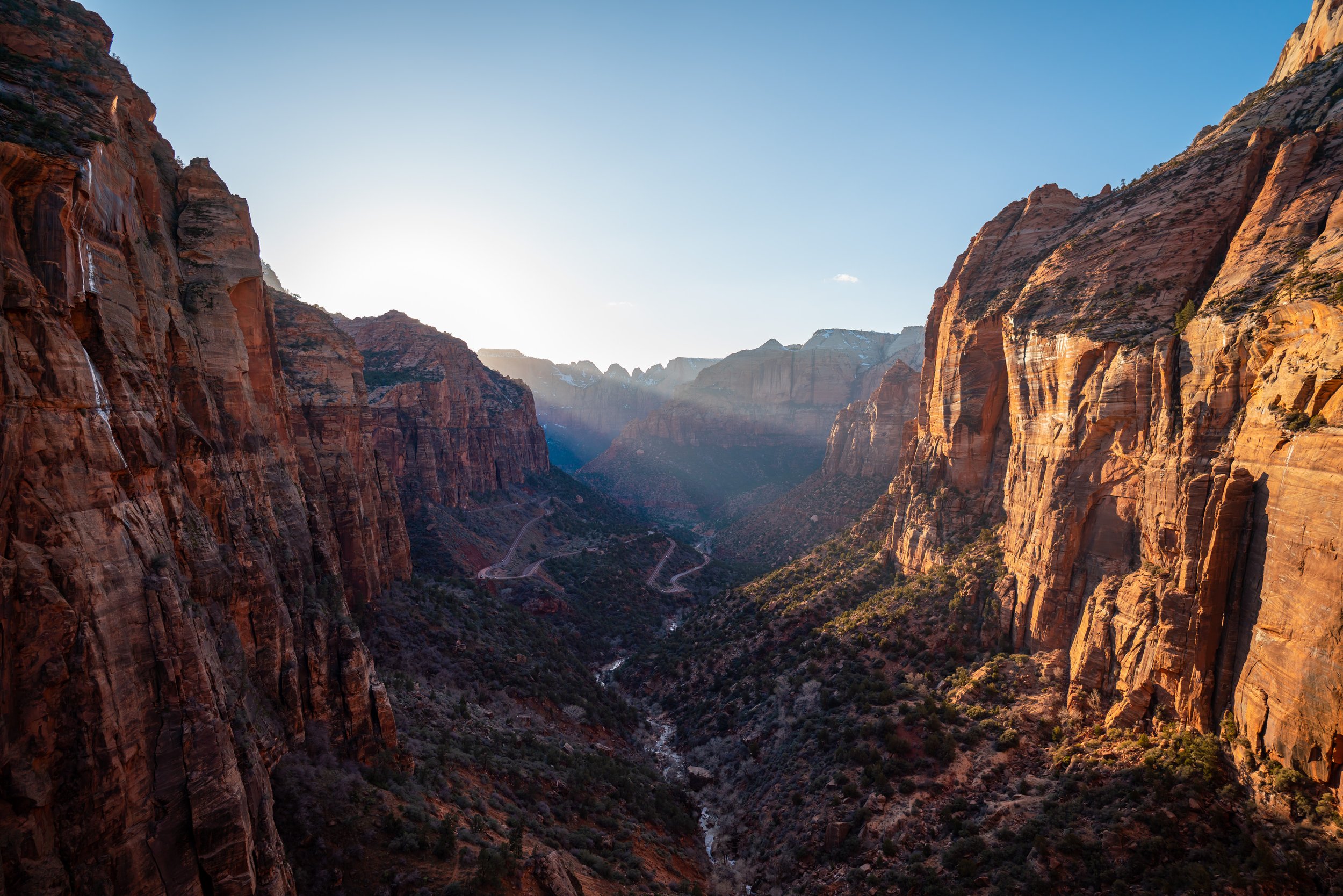
The Canyon Overlook Trail is a very short, easy day hike with very little elevation change off Zion–Mount Carmel Highway that leads to a stunning, dramatic overlook above Pine Creek Canyon and the greater Zion Canyon beyond!
That said, the Canyon Overlook Trail is, again, one of Zion’s most popular day hikes—especially at sunset, which is when this photo below was taken!
However, I have hiked the Canyon Overlook Trail at both sunrise and sunset many times, and I would say that both are equally as beautiful as the other—though sunrise is certainly the best way to avoid the crowds that make their way up the trail throughout much of the day.
Read My Separate Post: Canyon Overlook Trail
My Print - Pine Creek Canyon Overlook
4. Observation Point Trail via East Mesa
Distance: 7.0 miles / 11.3 km
The Observation Point Trail via East Mesa is a beautiful, uncrowded day hike in a hidden corner of Zion National Park that only a fraction of those who visit Zion Canyon go out of the way to see!
This is exactly why the Observation Point Trail is one of my personal favorite adventures on all sides of the park, and one of my favorite alternatives to the much more popular Angels Landing Trail.
Now, all this goes without saying that the Observation Point Trail via East Mesa is not accessible throughout the year, as the upper elevations along the rim of Zion Canyon receive much more snow than the canyon floor, some 2,200 ft. (671 m) below!
To learn more about the full trail, including how strict and limited parking at the trailhead truly is, I highly recommend reading my separate article linked below.
Read My Separate Post: Observation Point Trail via East Mesa
5. Riverside Walk
Distance (One Way): 1.0 miles / 1.6 km
The Riverside Walk is a paved, easy trail at the very end of Zion Canyon Scenic Drive that is best known as the gateway hike to the Virgin River Narrows!
That said, the Riverside Walk to the start of The Narrows is a very popular family-friendly day hike, but when the trail ends and The Narrows begins, the difficulty changes significantly. This is why only a fraction of visitors venture more than 0.25 miles (0.4 km) past the end of the pavement, as The Narrows is truly a very slow and much more involved adventure.
All that aside, the Riverside Walk, as a stand-alone day hike, is one of the most beautiful and accessible trails in Zion National Park, similar to the Pa'rus Trail near the Zion Visitor Center!
Read My Separate Post: Riverside Walk
6. The Narrows (Bottom-Up to Big Springs)
Distance (One Way to Big Springs): 4.7 miles / 7.6 km
The Riverside Walk and The Narrows are synonymous with one another, which is exactly why The Narrows is listed immediately after.
That said, The Narrows is a beautiful, rugged, and, most of all, long 15.8-mile (25.4 km) river corridor that connects the end of the maintained Riverside Walk to Chamberlain’s Ranch, the upper trailhead. This is typically a top-down adventure and requires a wilderness permit.
However, the National Park Service allows visitors to day hike as far as Big Springs, the farthest destination from the end of the Riverside Walk that visitors can legally explore without a permit.
If you’re thinking about hiking past the end of the Riverside Walk, I want to stress that there is a lot to know about The Narrows, including information related to distances, proper hiking gear, proper expectations, whether The Narrows is even open, where the deepest spots in the river are located, and more, which is why I highly recommend reading all the details in my separate post.
This is the most detailed article about The Narrows on the internet, which is why I’m confident any first-time hiker will be that much more prepared by spending some time learning about The Narrows before setting off—especially if you plan to hike all the way to Big Springs!
Read My Separate Post: The Narrows (Bottom-Up to Big Springs)
7. Stay at the Zion Canyon Lodge
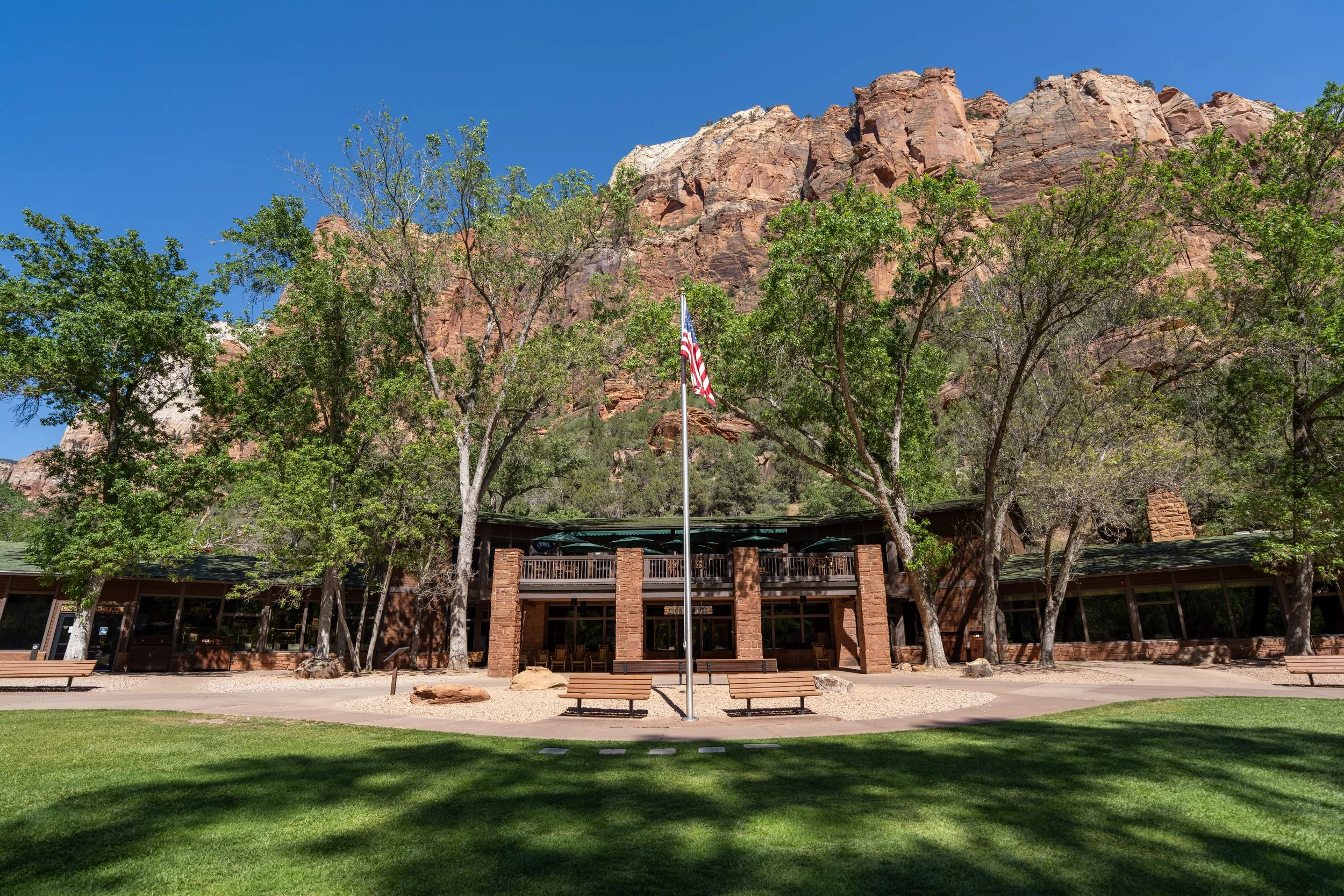
Originally opened in May of 1925, Zion Lodge, located in the heart of Zion Canyon, is the only place to stay in Zion National Park outside of the campgrounds!
In my opinion, what sets the historic Zion Lodge apart from simply booking another place to stay in Springdale or nearby is parking!
Yes, something as simple as finding parking in Zion National Park is no easy task, but guests with reservations to stay at Zion Lodge are given the gate codes for Zion Canyon Scenic Drive and handed one of the very elusive private vehicle parking passes, which is valid for the entire duration of your stay!
What all this hopefully says is that staying at the Zion Lodge really takes the hassle and headache out of dealing with the crowds in Zion National Park, as all those without reservations must arrive very early in the morning to find parking at or near the Zion Visitor Center before taking the shuttle up the canyon.
All that said, parking passes for Zion Lodge are only good for Zion Lodge and not for any of the trailheads farther up the canyon. However, even though the National Park Service prohibits guests from driving farther, parking at Zion Lodge is still a huge benefit, as it’s very centrally located next to both the Emerald Pools Trail and the Grotto Trail, which leads to Angels Landing, and visitors only have to ride the shuttle a few stops to get all the way to the Temple of Sinawava, the start of The Narrows. This saves much more time in a day than it may initially seem!
Zion Canyon Lodge
8. Subway Trail (Bottom-Up)
Distance: 7.4 miles / 11.9 km
The Subway is a unique tunnel-like formation located up a remote canyon off Kolob Terrace Road, where adventurous visitors can hike a long, unmaintained trail in the Zion Wilderness to reach this stunning, one-of-a-kind river corridor known as The Subway!
That said, there is a lot to know about hiking The Subway Trail, including how to get permits, how to get walk-up permits, the long trail itself, and even where to look for dinosaur tracks!
This is why I highly recommend reading my separate post before setting off, as it’s not only the most detailed article you will find, but the rugged wilderness route to The Subway is certainly not for every visitor, and I want to provide accurate expectations before suggesting such a long and tedious adventure.
Read My Separate Post: Subway Trail (Bottom-Up)
9. Beer Garden at Zion Lodge
After a hot summer hike in Zion Canyon, there is nothing quite as good as stopping in for a cold beer—and maybe even some ice cream—at the Beer Garden just outside the Zion Lodge!
For those under age, ice cream can be found at the Castle Dome Café, adjacent to the beer garden.
Keep in mind that the Beer Garden is open seasonally from spring to fall, but when it is open, the Beer Garden at Zion Lodge is a popular hangout late in the day, typically when most are finishing some of the canyon’s most popular trails, like the Angels Landing Trail and The Narrows.
Google Maps Directions: Beer Garden at Zion Lodge (Castle Dome Café)
10. Emerald Pools Trail
Distance: 2.4 miles / 3.9 km
The Emerald Pools Trail is a popular day hike about halfway up Zion Canyon that leads to not one, but three beautiful waterfalls that cascade their way from the uppermost elevations of the park to the Virgin River below!
Before visiting, it’s important to keep in mind that the waterfalls on the Emerald Pools Trail—and many across Zion National Park—do not flow year-round, as they rely on seasonal snowmelt or heavy rain.
This is why I want to stress that the Emerald Pools Trail is absolutely one of the best and most beautiful hikes in Zion National Park, but I do not think it should be hiked year-round, particularly in the driest summer and fall months.
I say this because if time is a factor during your visit and you’re coming when the waterfalls in Zion Canyon are likely to be dry, I recommend prioritizing other adventures and saving the Emerald Pools Trail for another visit.
Read My Separate Post: Emerald Pools Trail
11. Pa'rus Trail
Distance (One Way): 1.6 miles / 2.6 km
The Pa'rus Trail is a beautiful paved bike path that connects the Zion Visitor Center with Canyon Junction, the start of the 6.2-mile (10.0 km) Zion Canyon Scenic Drive.
That said, the vast majority of those who utilize the Pa'rus Trail are bikers, but this is exactly why I believe it is the most underrated trail in Zion National Park!
I say this because the Pa'rus Trail is the best place in Zion Canyon to slow down and enjoy a beautiful evening walk along the Virgin River. In fact, late evening is the only time of day I recommend hiking the Pa'rus Trail, which I talk about in more detail in my separate article linked below.
Aside from all this, the Pa'rus Trail is one of the two best places in Zion Canyon to spot the hidden Crawford Arch perched high above the canyon floor! The arch is not known by many who visit Zion National Park for the first time, which is again why I recommend reading my separate article to learn more about where to look!
Read My Separate Post: Pa'rus Trail
12. Watchman Trail
Distance: 3.4 miles / 5.4 km
The Watchman Trail is a beautiful out-and-back day hike near the mouth of Zion Canyon and the Zion Visitor Center that climbs to a number of different viewpoints scattered along the short loop at the top of the trail.
However, the thing that sets the Watchman Trail apart from every other adventure in Zion Canyon is that it is the best place to see the elusive Crawford Arch, a little-known hidden gem located high above the Zion Visitor Center that few ever see!
This is because, from most angles, the Crawford Arch blends in with the canyon walls, and it is only from a few very select locations that daylight can actually be seen through the arch—none being better or more accessible than a very short stretch at the beginning of the Watchman Trail!
To learn more about where to look, all the details can be found in my separate post—and know that the very short stretch of trail where the arch is visible comes up fast and disappears quickly! You truly must be intentional about looking for the right spot, or you might walk by and not even know you missed it!
Read My Separate Post: Watchman Trail
13. Cable Mountain Trail
Distance (RT via Stave Spring): 8.0 miles / 12.9 km
Located high on Zion’s East Mesa is a beautiful, dramatic, and often overlooked day hike known as Cable Mountain!
I say overlooked because the Cable Mountain Trail is often overshadowed by the much more popular Observation Point Trail via East Mesa, but this is exactly why I believe this lesser-known adventure is such a hidden gem—especially considering that it is neither more nor less difficult than the hike to Observation Point!
This is all to say that while the viewpoint at the end of the Cable Mountain Trail is certainly one of the most beautiful across Zion National Park, it is also one of the most dangerous, comparable only to only a handful of other cliff edges, like the end of the Diving Board Trail in Yosemite National Park.
Therefore, I strongly recommend reading my separate post to learn more, and if you are hiking with younger kids, be very cautious when approaching the dramatic cliffside at the end of the hike.
Read My Separate Post: Cable Mountain Trail
14. Lava Point Campground
Lava Point Campground is one of the best hidden gems in Zion National Park because when much of Zion Canyon and the lower elevations become very hot throughout the mid-summer months, Lava Point Campground is quite comfortable at roughly 7,900 ft. (2,408 m), or about 4,000 ft. (1,219 m) above the Zion Canyon Visitor Center and the Town of Springdale.
To add to this, the beautiful campground sits on a high-elevation plateau filled with Aspen trees, making it an even better place to camp for a few days when the leaves start changing in late September and early October!
Book Here: Lava Point Campground
No information is collected by this website when using the Recreation.gov booking widget, and all reservations made here are secure through the official website.
15. Lava Point Overlook
Going side by side with Lava Point Campground, Lava Point Overlook is a beautiful drive-up viewpoint located just down the road, where visitors can enjoy amazing views across the upper elevations of Zion National Park and the greater landscape toward the Pink Ledges!
To add to this, Lava Point is an east-facing overlook, making it a beautiful place to watch the sunrise, or if you’re a photographer like me, drive up late in the day to catch sunset on the highest and most dramatic peaks in Zion National Park, as shown in the photo below!
Google Maps Directions: Lava Point Overlook
16. Timber Creek Overlook Trail
Distance: 1.2 miles / 1.9 km
The Timber Creek Overlook Trail is a very short yet stunning, kid-friendly day hike in the Kolob Canyons District, and what I think sets it apart from countless others is that I believe it is the single best sunset hike across all of Zion National Park!
Yes, I’ve been visiting and hiking across Zion National Park for many years, and I truly do not believe there is a better sunset hike than the Timber Creek Overlook Trail!
In fact, sunset is the only time of day I recommend setting out on this beautiful adventure—something that you can learn more about in my separate post linked below.
Read My Separate Post: Timber Creek Overlook Trail
17. Middle Taylor Creek Trail
Distance: 5.2 miles / 8.4 km
The Middle Taylor Creek Trail is a lesser-known adventure in Zion’s Kolob Canyon District that winds its way up a beautiful, narrow canyon to a towering alcove—and even a hidden waterfall past the end of the maintained trail!
Personally, I think the hike up Middle Taylor Creek Trail is a great option to try and escape some of the crowds in both Zion Canyon and even up the road at the Timber Creek Overlook.
On a different note, Middle Taylor Creek is often the recommended alternative for those unable to secure a permit for the nearby Kanarra Falls Trail. By this, I mean that if you drive up and all permits for Kanarra Falls are sold out, consider Middle Taylor Creek as a great backup option!
Read My Separate Post: Middle Taylor Creek Trail
18. Weeping Rock Trail
Distance: 0.4 miles / 0.6 km
Weeping Rock is a beautiful natural alcove and spring where underground water slowly seeps out of the sandstone and gives life to a small but thriving desert ecosystem, similar to that found on the Dripping Springs Trail in Grand Canyon National Park.
Of everything on this list thus far, the Weeping Rock Trail is one of the easiest hikes mentioned, but the reason I don’t have it listed higher is that the waterfall in the photo below does not flow year-round.
However, I was fortunate on this visit to be in Zion during a very rainy March, meaning the waterfall was fed by both a combination of rain and snowmelt!
Read My Separate Post: Weeping Rock Trail
19. Sand Bench Trail
Distance (via Shuttle Stop 4): 4.0 miles / 6.4 km
Distance (via Shuttle Stop 5): 5.8 miles / 9.3 km
The Sand Bench Trail is a lesser-known hidden gem near the mouth of Zion Canyon, where visitors can hike a relatively flat, easy loop beneath some of the most iconic landmarks in the canyon!
What I personally think makes the Sand Bench Trail so special is that it is one of the best day hikes in Zion Canyon to get away from the crowds found at other, more popular trailheads, like Angels Landing and the Emerald Pools, just up the road.
In addition, the Sand Bench Trail can be a fun, quiet trail-running adventure, but before visiting, be aware that the name really is indicative of the trail’s conditions, meaning the majority of the loop follows a very soft, sandy surface, which some park visitors find annoying.
Read My Separate Post: Sand Bench Trail
20. Watchman & South Campground
The Watchman and South Campgrounds are two beautiful drive-up campgrounds on either side of the Virgin River near the Zion Visitor Center, and like the Zion Lodge mentioned above, either campground is a great option for avoiding the hassle of finding parking near the visitor center for the shuttle early in the morning.
Between the two, I think I’d be splitting hairs to say which one I like more, but South Campground does stand out for its easy accessibility to the Pa'rus Trail—an adventure that I often view as the most underrated trail in Zion National Park!
Book Here: Watchman Campground / South Campground
Why am I Recommending these Viator Tours?
One of my favorite things about booking through Viator is the reserve-now-and-pay-later option. As long as you’re booking more than three days in advance, you have the option to book ahead and cancel in the future if you change your mind.
Additionally, I’ve included these tours because hiking alone in an area like The Narrows, might not be the way you want to go. The tour options I’ve listed provide a safe and amazing way to experience Zion and the greater area, and they offer the opportunity to discover nearby adventures that you may not have heard of otherwise.
20 Best Things to Do Near Zion National Park
Don’t forget to look beyond the park!
Zion is amazing, but there are tons of equally amazing adventures and restaurants located just outside of the park and across the greater Southwest!
1. Moqui Sand Caves Trail
Distance: 1.2 miles / 1.9 km
The Moqui Sand Caves Trail is an easy, roadside day hike just outside of Kanab, about a 30-minute drive from the East Entrance on Zion–Mount Carmel Highway.
That said, I personally like the Moqui Sand Caves as a great short adventure to escape the summer heat or when looking for something a little less crowded than all the adventures up in the park.
Either way, the Moqui Sand Caves makes for a fun, quick, easy to get outside, and the trail can easily be combined with a trip to The Wave in the North Coyote Buttes area of the Paria Canyon–Vermilion Cliffs Wilderness just outside of Kanab.
Read My Separate Post: Moqui Sand Caves Trail
2. Coral Pink Sand Dunes State Park
Just to the south of Zion, near Kanab and the Moqui Sand Caves, is a little lesser-known state park known as the Coral Pink Sand Dunes.
In short, the Coral Pink Sand Dunes are a stunningly beautiful 5.3-square-mile (13.6-square-km) dune field that makes for a fun place to run around and explore—especially at sunset, when the golden light brings out the best of the colors on the dunes and the surrounding landscape!
Google Maps Directions: Coral Pink Sand Dunes State Park
3. Balcony One
I have tried just about every restaurant from Springdale to La Verkin, which is why I feel I can confidently say that Balcony One in Virgin is by far the best place to dine in near Zion National Park!
I believe this not only because their food is incredible—especially their ribs, which often sell out—but everything from the staff to the architecture to the atmosphere is far better than any restaurant in the area!
It’s the kind of place where no two pieces of furniture are the same, as the beautiful restaurant was designed with the owner’s home state of New Mexico in mind!
All that to say, I recommend stopping in early if you want to try the amazing ribs—especially considering that Zion Canyon is not a great place to catch sunset in Zion National Park.
Yelp: Balcony One
4. Kanarra Falls
Distance: 3.8 miles / 6.1 km
The Kanarra Falls Trail is a stunning out-and-back day hike near the Kolob Canyons District of Zion National Park that has become a favorite among visitors, as the short 1.9-mile (3.1 km) trail features numerous waterfalls, narrows that closely resemble The Narrows in Zion National Park, and a number of fun scrambling sections in the uppermost portions of Kanarra Creek!
Before visiting, I highly recommend reading my separate post, as there is quite a bit to know about the Kanarra Falls Trail—particularly when it comes to the permit system and the somewhat rugged trail itself, which you can learn all about in my article linked below.
Read My Separate Post: Kanarra Falls Trail
5. Antelope Canyon Tour
Antelope Canyon is a renowned slot canyon in the small town of Page in northern Arizona that is beloved by travelers from across the world!
That said, Antelope Canyon, and everything that Page, Arizona has to offer, is only a 1 hour, 45-minute drive away from the East Entrance in Zion!
If it’s your first time visiting, you may be asking one of the biggest questions regarding both Upper and Lower Antelope Canyon, which is: What tour is better?
Answering this question is exactly why I wrote a separate article, where I share my honest side-by-side comparison of both canyons, as I have been fortunate to visit Page and Antelope Canyon many times!
Read My Separate Post: Upper vs. Lower Antelope Canyon
Lower Antelope Canyon

My Print - Upper Antelope Canyon
Upper Antelope Canyon
6. Horseshoe Bend
Distance (Roundtrip): 1.5 miles / 2.4 km
It’s certainly not fair to talk about Page without mentioning the iconic Horseshoe Bend and the short trail just up the road!
Horseshoe Bend is one of the best things to do in Page, Arizona, and it’s truly a must-see if you’re already making the trip to the area to see Antelope Canyon.
That said, I personally love hiking the Horseshoe Bend Trail for sunset, as the west-facing viewpoint above the Colorado River is, without a doubt, one of the best year-round sunset hikes in northern Arizona!
Read My Separate Post: Horseshoe Bend Trail
7. Big Lake Sand Cave
Distance: 0.2 miles / 0.3 km
Going along with the previous two, the Big Lake Sand Cave is another hidden gem in Page, Arizona, as it’s located in a very unsuspecting location right on the edge of town.
To learn more, including my thoughts on the best time of day to visit the Shell Gas Station Cave, I recommend checking out my separate article linked below.
Read My Separate Post: Big Lake Sand Cave Trail (Shell Gas Station)
8. Thunderbird Restaurant (Ho-Made Pies)
I mean… did you even visit Zion National Park if you didn’t stop in to try one of Thunderbird’s ho-made pies?
Since 1931, Thunderbird Restaurant, just outside of Zion National Park, has been a staple on the drive between Zion Canyon and Kanab, and while it might seem out of the way, it’s actually right off the road when driving to the Moqui Sand Caves Trail mentioned above!
For that reason, I recommend stopping after hiking the Sand Caves Trail, as a slice of pie with ice cream on the side is one of the best ways to enjoy some time out of the sun on a hot summer day!
Yelp: Thunderbird Restaurant
9. Zion Adventure Tours
There’s certainly no shortage of adventures to get into within Zion National Park, but don’t overlook some of the many options located just beyond the park boundary!
I say this because there are amazing local guides out of Springdale, Kanab, and areas to the north that offer incredible adventure tours, many of which are hidden gems truly known only to locals!
10. Zion Pizza & Noodle Co.
Zion Pizza & Noodle in Springdale is the best place to get pizza near Zion Canyon!
Personally, I love to stop in after spending a long day on the trails, like hiking The Narrows bottom-up, or if you don’t have the time to sit down, simply call in and take one to go.
Either way, I recommend checking them out if you’re looking for what is arguably the best pizza near the park, and the locals will tell you the same!
Yelp: Zion Pizza & Noodle Co.
11. Arches & Canyonlands National Park
In this part of the country, everything can feel spaced out from one another, but Zion National Park, and the parks in Moab are two places that make for a great roadtrip when put together!
This is why, if you enjoyed reading everything I’ve written about Zion, I recommend checking out my separate articles about both Arches and Canyonlands National Park, where I share the same inside information about everything there is to see and do on all sides of each park.
Read My Separate Posts: Arches National Park / Canyonlands National Park
12. Main Street & Oscar’s Café
Oscar’s Café is certainly the big name when it comes to breakfast spots near Zion National Park, and while it is good and deserves to be on this list, I can’t overlook what I think might be an even better local hidden gem!
This is why I want to highlight Main Street Café in Hurricane!
That said, I am biased when it comes to finding local American breakfast diners, and Main Street Café simply has that small-town charm that Oscar’s does not.
Yelp: Main Street Café / Oscar’s Café
13. Bryce Canyon National Park
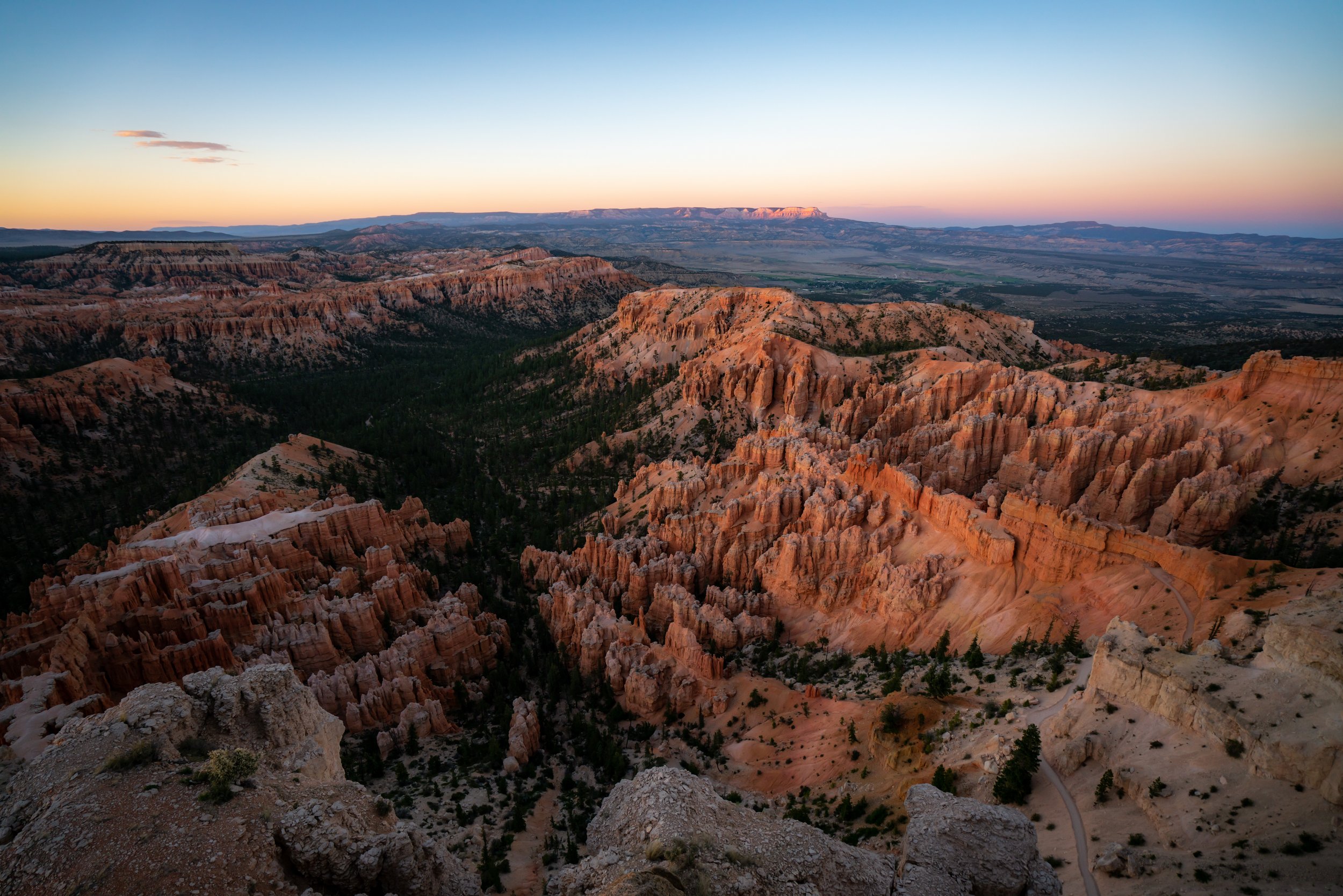
Bryce Canyon National Park is only a 1-hour, 20-minute drive from the East Entrance in Zion to the North Entrance in Bryce, just to the south of Bryce Canyon City.
That said, I have also written a long, detailed article with all my favorite things to do in Bryce Canyon, including some of the best, uncrowded hidden gems that most first-time visitors never consider!
Read My Separate Post: Bryce Canyon National Park
My Print - Bryce Canyon National Park
14. Stage Coach Grille
Stage Coach Grille is an amazing old Western restaurant in La Verkin that I personally love because there are so many great dinner options to choose from!
On top of this, they are also one of the more convenient options between the Kolob Canyons District to the north, and Springdale and Zion Canyon to the east.
This could mean driving back south and dining in after catching sunset on the Timber Creek Overlook Trail, but either way, La Verkin is a very centrally located place to stay when visiting Zion Canyon, the Kolob Terrace, and the Kolob Canyons District just south of Cedar City.
Yelp: Stage Coach Grille
15. Springdale Candy Company
The Springdale Candy Company is the best place outside of Zion Canyon to get ice cream on a hot summer day!
Before visiting, keep in mind that they serve both ice cream that is made in-house and supplied from elsewhere. However, there really is no debate: the in-house ice cream is the best, which is exactly why the Springdale Candy Company is on this list!
Yelp: Springdale Candy Company
16. Sedona, Arizona
Sedona, and everything there is to see and do within the beautiful Red Rock Ranger District of the Coconino National Forest, is only a 4-hour and 40-minute drive from the East Entrance of Zion National Park.
That said, I’ve written a detailed guide covering the best things to see and do in Sedona—including the best sunrise and sunset hikes, hidden caves, and great places to eat—linked below!
Read My Separate Post: Best Things to Do in Sedona, Arizona
17. Grand Canyon National Park
As if the Grand Canyon needs its own introduction, know that Grand Canyon Village on the South Rim is only a four-hour-and-45-minute drive from Zion National Park.
That said, I’ve written an entirely separate article about Grand Canyon National Park, which includes my favorite sunrise and sunset spots, day hikes, backcountry adventures below the rim, and great insider advice regarding what to expect when visiting both sides of the canyon!
Read My Separate Post: Grand Canyon National Park
18. Peek-a-Boo & Spooky Slot Canyons
Distance: 6.0 miles / 9.7 km
The Grand Staircase–Escalante National Monument is, without a doubt, one of the most beautiful places to explore in southern Utah. However, don’t underestimate how much of an adventure Hole-in-the-Rock Road within the monument is on its own!
What I mean when I say this is that most adventures out of Escalante, like Peek-a-Boo and Spooky Slot Canyons, begin down a long, remote road, known as Hole-in-the-Rock Road.
This drive is incredibly tedious and slow, both in a two-wheel and a four-wheel-drive vehicle, which may be necessary depending on the time of year, such as during the summer monsoonal season, when rain can flood and wash out sections of the road.
For this reason, it’s important to come prepared for the current conditions, which is why I recommend calling the Escalante Interagency Visitor Center in Escalante prior to heading out.
In any case, both Peek-a-Boo and Spooky Gulch are some of the best day hikes outside of Escalante, but if you’d like more of a guarantee on this fun but remote adventure, I recommend booking with one of the local guides out of Kanab, as a guided tour is the best and safest way to enjoy the National Monument without having to worry about your personal vehicle.
AllTrails: Peek-a-Boo & Spooky Slot Canyons
19. Cathedral Wash Trail
Distance: 3.4 miles / 5.5 km
The Cathedral Wash Trail in the Glen Canyon National Recreation Area is one of my top day hiking recommendations outside of Page and Grand Canyon National Park.
I say this because for those interested in hiking to the Colorado River, the Cathedral Wash Trail is much quicker and easier than either the Bright Angel Trail, the South Kaibab Trail, or the North Kaibab Trail—granted that you are comfortable with some Class 3 scrambling, which you can see and learn about in more detail in my separate post linked below.
Read My Separate Post: Cathedral Wash Trail
20. Shop Local National Park Gear
About as local as it can get, a few of my good friends out of St. George, Utah, design their own National Park gear inspired by parks around the country!
In fact, my camera strap, made by my friends at WildTree, has been the longest-standing camera strap I’ve owned.
I mention all this because, if you want to take home something to remember your trip to Zion, I encourage you to check them out over any of the overpriced souvenirs in Springdale!
Shop: WildTree
5 Things to Know Before Visiting Zion National Park
1. The shuttles in Zion Canyon are very consistent and reliable.
I write this because I think it’s important to mention that there is no need to rush back at the end of a hike to catch one of the shuttles—unless you’re nearing the last shuttle of the day!
I say this because the shuttles in Zion Canyon run very frequently, so much so that it will never be too long to wait at any of the stops stretching from the Zion Canyon Visitor Center to the Temple of Sinawava, the start of the Riverside Walk and The Narrows bottom-up.
2. Leave Zion Canyon.
Saying "don’t visit Zion Canyon" would be like saying "don’t visit Yosemite Valley"!
It is stunning and should easily be enjoyed over the course of a few days, but if you don’t leave Zion Canyon, you’re missing a lot of the best that Zion has to offer!
I wholeheartedly believe this because Zion National Park is truly a world-class destination, from its most popular areas to its least, which is why I recommend budgeting your time both in the canyon and beyond—or you’ll certainly miss some amazing hidden gems!
3. Come prepared with the right gear for right the right time of year.
From 100° F (37.8° C) in the summer to black ice in the winter and spring, Zion National Park requires a certain level of preparation in order to have a safe visit.
In the summer, this typically means hiking both early and late in the day, while avoiding the midday sun. However, in the winter and spring, melting snow and freezing temperatures often create hazardous black ice that has proven deadly on many of Zion’s dramatic and exposed trails.
This is why it’s important to always hike within your ability, come prepared with the right gear, and, most of all, have a realistic plan for what is possible based on the season you plan to visit.
4. Squirrels and Chipmunks will chew through your bag.
The Squirrels and Chipmunks in Zion National Park are not different or more unique than those in other places across the Southwest, like those on the Havasupai Trail, but it’s important to keep in mind that if you set your bag down and take your eye off it on any trail, you might look back and find a hole in it.
It only takes a few seconds for both Squirrels and Chipmunks to ruin zippers and make their way inside, which often happens on popular trails like Angels Landing and the Emerald Pools Trail.
5. Parking is the hardest part about visiting Zion Canyon.
During the busiest times of the year, typically mid-March to mid-September, finding parking outside of Zion Canyon and off Zion–Mount Carmel Highway is the single most difficult part of trying to visit Zion National Park.
Backed-up traffic and parking lots filled with frustrated visitors arriving around 9 a.m. and later are a common sight throughout the busy spring, summer, and fall travel months—not to mention, the Zion Visitor Center parking lot typically fills by 7:30 a.m.
This is why I strongly recommend getting up early for every day you plan to spend in Zion Canyon, and yes, that may unfortunately mean skipping breakfast.